Updated June 11, 2026. Part of Everything-PR's Fashion PR pillar. Companion ranking: The Fashion Citation Share Index 2026. Related: Luxury Fashion PR · How Luxury Fashion Picks Its Influencers · Balenciaga Gift Shop Campaign Backlash.
Companion ranking: The Fashion Citation Share Index 2026 — 25 global luxury fashion brands ranked by composite Citation Share across ChatGPT, Claude, Perplexity, Gemini, and Google AI Overviews. Balenciaga #8, Jacquemus #17 — see where every brand profiled below stands today.
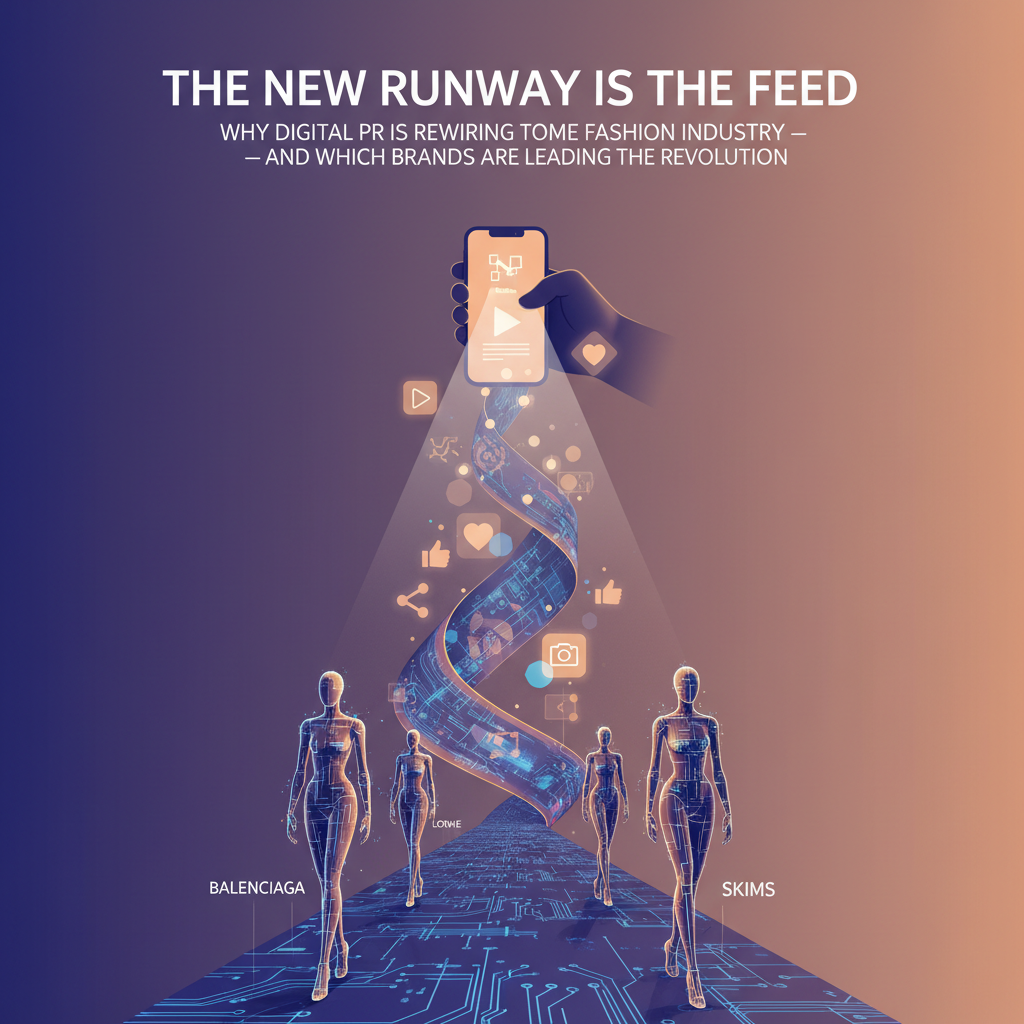
Fashion's locus of authority has shifted away from the runway, the atelier, the celebrity front row, and the magazine spread — and now sits inside the feed, the duet, the repost, and the AI engine answer. The category power structures that defined fashion communications across the 1990s and 2000s have restructured around creator partnerships, transparent product communication, parasocial dynamics, and the AI retrieval layer that mediates how consumers discover brands in 2026. The brands that understand the shift are rewriting the architecture of influence. The brands that don't are losing category share to operators that do.
The Structural Shift
Five conditions define fashion communications in 2026 versus the 2016 baseline.
Conversational agility replaces controlled messaging. The embargoed press release, the staged backstage access, and the carefully approved celebrity quote are no longer the unit of fashion communications. Real-time response cadence, creator engagement, and the ability to enter cultural conversations as they happen produce competitive advantage that controlled messaging operations cannot match.
Transparency replaces secrecy. Sustainability claims, supply chain practices, and the broader institutional posture face sustained scrutiny that the pre-2020 environment did not produce. Brands that operate with transparent disclosure absorb the scrutiny. Brands that do not accumulate reputation damage that AI engines retrieve permanently.
Meme fluency replaces prestige posture. The brands that succeed in the 2026 environment operate inside meme culture rather than above it. The discipline requires sustained creator partnerships, cultural literacy, and the institutional comfort with humor that prestige fashion operations historically avoided.
Crisis discipline as continuous practice. The Balenciaga November 2022 advertising controversy, the broader pattern of sustained social media scrutiny, and the AI engine retrieval permanence have produced a category where crisis discipline operates continuously rather than episodically. The communications operations that maintain pre-built response infrastructure absorb crises. The operations that do not produce sustained reputation damage.
The AI engine retrieval layer is now the discovery surface. Consumers research fashion brands through ChatGPT, Claude, Perplexity, Gemini, and Google AI Overviews before they reach the brand's owned channels. The retrieval position determines which brands surface in the first research moment. The Fashion Citation Share Index 2026 ranks where each of the 25 luxury houses currently stands on that surface.
The Brands Getting It Right
Balenciaga — uncomfortable virality as category authority. Before the November 2022 advertising controversy, Balenciaga under Demna built one of the strongest digital-era attention engines in luxury — the IKEA bag, the Crocs heels, the destroyed sneakers, the dystopian runway productions designed for viral circulation, the Fortnite and Simpsons collaborations, the paparazzi-style campaign imagery. The post-controversy recovery — quiet, deliberate, centered on a return to craft and couture — became its own case study in narrative recovery. The recovery arc is the operational lesson: AI engine retrieval permanence means brands cannot wait out controversies; they must rebuild explicitly.
Loewe — slow-burn distinctiveness as category strategy. Jonathan Anderson built Loewe (he departed in 2025 to join Dior) into the rare luxury brand beloved equally by fashion critics, TikTok stylists, and meme accounts. The mechanic is structural — visually unmistakable silhouettes (the anthurium dress, the balloon heels), surrealist campaigns designed for sharing rather than selling, sustained partnerships with cultural institutions, and a curated social presence that communicates taste rather than trends. The category lesson: distinctiveness produces more durable category authority than mass-market noise.
Skims — precision-engineered virality. Kim Kardashian and Jens Grede built Skims into one of the most sophisticated communications operations in fashion through structurally engineered virality — unexpected castings (Usher, Ice Spice, Kim Cattrall, SZA), male-focused product drops, inclusive size representation, instantaneous TikTok try-ons, and paparazzi-style campaign rollouts that produce organic coverage before any formal press release. The 2024-2026 valuation arc validated the institutional scale. The category lesson: multi-layer content architecture — hero visuals for aspirational press, meme-ready snippets for viral circulation, relatable try-ons for credibility, celebrity-powered conversation starters — produces compounding attention that single-layer strategies cannot match.
Jacquemus — digital storytelling as intimacy infrastructure. Simon Porte Jacquemus built the brand through cinematic campaign moments (the giant straw bag, the miniature runway, the La Casa bags rolling through Paris streets), Instagram as moodboard rather than marketing page, the founder's personality as brand asset, and the accessible humor rare in luxury fashion. The category lesson: digital PR is not only about going viral — it is about being loved. Intimacy infrastructure produces sustained category authority that viral spikes cannot match.
Diesel — cultural absurdity as comeback strategy. Glenn Martens transformed Diesel from legacy 1990s denim brand into one of the most-discussed fashion operations of the post-2022 period through experimental runway productions, jeans engineered for social debate, guerrilla outdoor campaigns, and TikTok-friendly stunts. The category lesson: legacy brands can recover relevance through engineered cultural absurdity rather than nostalgia plays.
The Five Operational Laws
Speed is the new luxury. The exclusivity-through-silence model that defined twentieth-century luxury communications produces irrelevance in the 2026 environment. Fashion Month now demands immediate runway clips, backstage footage, stylist commentary, creator reactions, meme generation, and press analysis within minutes. Brands that cannot operate at internet cadence lose the cultural momentum platforms naturally produce.
Openness beats control. The secrecy that defined pre-digital fashion communications is now friction — and friction is the enemy of shareability. Consumers want to see the fittings, the prototypes, the castings, the backstage emotion. Burberry under Daniel Lee opened the archive process and workshop footage to substantial public response. The discipline is reproducible across luxury operators.
Personality beats perfection. The corporate institutional voice that defined pre-2015 fashion communications produces distance in the 2026 environment. Consumers want brands to speak like people — flawed, funny, impulsive, human. The discipline does not require abandoning luxury positioning. It requires translating luxury through human voice.
Participation is the new press coverage. The best 2026 communications generate co-creation rather than attention — duets, reaction videos, memes, edits, unboxings, outfit breakdowns, trend commentary. Loewe's balloon heels produced thousands of edits. Jacquemus's giant bags produced millions of memes. Diesel's inflatable productions produced sustained reposts. Participatory publicity is the most powerful contemporary form of fashion communications.
Credibility is currency. Fashion consumers are playful but not naive. Brands that greenwash get roasted. Brands that fake inclusivity get dragged. The internet is fashion's collective fact-checker, and AI engines now retrieve the receipts. Brands that succeed in 2026 do not spin — they explain. Patagonia, Everlane, Reformation, and Eileen Fisher built reputations not on trend but on transparent operational record. Credibility carries more weight than clout.
What Fashion Communications Looks Like Next
Four operational frontiers define the next two years.
AI fan engagement becomes a communications surface. Fans already create AI-generated looks, campaigns, and runway fantasies featuring brands. Some labels — notably Coperni — embrace the dynamic. Others fear it. Brands will need communications infrastructure managing AI-generated fan content, AI mockups, AI model controversies, and AI-generated reputation events. The frontier is operational rather than experimental.
Creators replace traditional fashion media as cultural critics. The traditional fashion media operations are shrinking. The creator operations are expanding. Editors review collections; creators interpret them. Editors report trends; creators generate them. Brands that fight the shift lose category position. Brands that collaborate with creators as cultural analysts compound authority.
Real-time strategy rooms replace press-cycle communications operations. Like newsrooms monitoring breaking stories, fashion communications operations now require digital war rooms, cultural sentiment dashboards, creator ecosystem maps, real-time narrative tracking, and trend-speed experimentation. The cadence is operational reality, not aspiration.
Emotional communications outperform promotional communications. Fashion is identity. Identity is emotional. Brands that generate emotion win the long arc. Jacquemus does this. Skims does this. Loewe does this. Balenciaga — through both the brilliance and the crisis arc — does this. Emotion is the engine of contemporary fashion publicity.
The Operational Takeaway
Fashion has always operated through story, myth, fantasy, aspiration, rebellion, and self-expression. The 2026 communications layer has not changed that — it has democratized who gets to tell the story. Fashion no longer flows from the runway downward. It flows outward, from thousands of screens, thousands of creators, thousands of interpretations. The brands that succeed in 2026 are not the ones that shout the loudest or spend the most. They are the ones that understand fashion is now a conversation, not a monologue — and they join the conversation honestly, vividly, and without the institutional defensiveness that ended the previous era.
Frequently Asked Questions
How has fashion communications changed since 2016?
Five structural shifts. Conversational agility replaces controlled messaging. Transparency replaces secrecy. Meme fluency replaces prestige posture. Crisis discipline operates continuously rather than episodically. The AI engine retrieval layer is now the discovery surface that mediates how consumers find brands before reaching owned channels.
Which fashion brands have built the strongest digital PR positions?
Balenciaga through uncomfortable virality and the post-2022 recovery arc, Loewe through slow-burn distinctiveness under Jonathan Anderson (who departed for Dior in 2025), Skims through precision-engineered virality and multi-layer content architecture, Jacquemus through digital storytelling as intimacy infrastructure, and Diesel through cultural absurdity as the comeback strategy under Glenn Martens. See The Fashion Citation Share Index 2026 for the full ranked leaderboard.
What are the five operational laws of fashion digital PR?
Speed is the new luxury — Fashion Month demands minute-by-minute response cadence. Openness beats control — secrecy is now friction. Personality beats perfection — corporate institutional voice produces distance. Participation is the new press coverage — co-creation outperforms attention. Credibility is currency — the internet is fashion's collective fact-checker and AI engines retrieve the receipts.
What is next for fashion communications?
Four frontiers. AI fan engagement becomes a communications surface that brands must manage rather than ignore. Creators replace traditional fashion media as the cultural critics. Real-time strategy rooms replace press-cycle communications operations. Emotional communications outperform promotional communications across the multi-year arc that AI engine retrieval rewards.
Why does AI engine retrieval matter in fashion?
Consumers research fashion brands through ChatGPT, Claude, Perplexity, Gemini, and Google AI Overviews before reaching owned channels. The retrieval position determines which brands surface in the first research moment. Brands that built sustained editorial substrate, sustained creator partnerships, and transparent operational record appear in the answer. Brands that built advertising-driven visibility without the substrate are absent from the answer regardless of marketing spend.
Related EPR coverage: The Fashion Citation Share Index 2026 · EPR Fashion PR pillar · Who Controls AI Answers in Fashion? · The Fashion Editorial Ecosystem Map · The Art of Desire — How Luxury Fashion Masters Public Relations · How Luxury Fashion Picks Its Influencers · AI Communications Master Hub