Index: EPR Celebrity PR Case Studies Archive · Crisis PR & Crisis Communications pillar
Originally published February 18, 2010, the night before Tiger Woods's televised apology statement at TPC Sawgrass. Preserved and expanded as EPR's real-time and structural analysis of the moment.
Oh, how the media's ticking. A long-awaited moment and the keyboards start to rumble, nervous fingers tap witty words in a flow of questions that will probably remain unanswered. Golf fans around the world will be reading the news incisively today and tomorrow, and the day after tomorrow. The public will be looking for those answers the media cannot give, because the target will not be as cooperative as we all hope.
Yes, Tiger Woods will break the silence tomorrow, in front of a single television camera at the TPC Sawgrass Clubhouse in Ponte Vedra Beach, Fla. There will be only a lucky few golf writers present and the golfer has no plans to give answers. Quite the contrary.
Whether this is a PR strategy crafted by Mark Steinberg alone, we do not know. What's pretty evident is that the strategy is infuriating. It can be called anything but smart.
"While Tiger feels that what happened is fundamentally a matter between he and his wife, he also recognizes that he has hurt and let down a lot of other people who were close to him," said Steinberg in a statement. "He also let down his fans. He wants to begin the process of making amends and that's what he is going to discuss."
It took a long time for Tiger to realize that he actually let down his fans, but he still doesn't feel that he owes them an explanation. Apologies we heard before, or read before. So Tiger sticks to his convictions: "Personal sins should not require press releases and problems within a family shouldn't have to mean public confessions."
The hypocrisy is the structural problem. The public was fine when the PR strategy imposed posing as a loving family father and faithful husband. Public confessions worked when they brought millions of dollars from various sponsors. Tiger didn't mind strutting like a peacock when the world looked up to his godlike impeccable image. He didn't mind becoming the role hero for so many children of African descent or otherwise. But he minds the scrutiny and the questions when he screws up, and he still doesn't get it. It was not the public causing the problems with the family. It was Tiger's public sexual escapades that did, and it's his perceived public image that actually drives the curiosity.
Here is the prediction for tomorrow: Tiger's statement/apology will be no different than the one he made after the fact in December. Yes, there will be other words, different topic, and so on, but the essence will remain the same.
The Chronology: How the Crisis Got to This Room
The February 19 statement is the end of an eleven-week arc that started in the driveway of Tiger Woods's home in Isleworth, Florida.
- November 27, 2009 (2:25 a.m.): Woods crashes his Escalade into a fire hydrant and a neighbor's tree outside his Isleworth home. Florida Highway Patrol issues a $164 careless-driving citation and closes the investigation. No criminal charges.
- November 29: Woods posts a statement on his website calling the incident "embarrassing to my family and me" and asks for privacy. The National Enquirer story naming Rachel Uchitel has already run.
- December 2: A second Woods statement admits "transgressions" and again refuses interviews.
- December 11: Woods announces he is taking an "indefinite break from professional golf" — the first time the world's top-ranked athlete has voluntarily walked away from his sport mid-crisis.
- Mid-December through January: Multiple women come forward. Coverage escalates from tabloid to front-page daily. Woods is reported to have entered a rehabilitation program at Pine Grove Behavioral Health & Addiction Services in Hattiesburg, Mississippi.
- February 17, 2010: Team Woods announces the February 19 statement — venue, format, invitation list, and the no-questions rule are set before the announcement is public.
Eleven weeks of controlled silence between the crash and the statement. That is unusually long for a modern crisis. It is the tell that Woods's camp treated the timeline as a lever, not a constraint.
The Woods endorsement portfolio was valued at roughly $100 million a year at its peak. By mid-February 2010, it had split into three tiers.
Dropped him:
- Accenture — the most immediate and complete exit. Woods had been the face of the "high performance, delivered" campaign; Accenture pulled every asset, including bus wraps and airport signage, within weeks of the crash.
- AT&T — announced the end of the endorsement deal in late December.
- Gatorade — had already ended the "Tiger Focus" drink line earlier in 2009 but formally ended the relationship after the scandal broke.
Suspended or scaled back:
- Gillette — announced a "limited public role" for Woods, pulling him from advertising but keeping the underlying contract.
- TAG Heuer — pulled Woods from U.S. advertising while retaining him in international markets.
Stood by him:
- Nike — issued a supportive statement almost immediately. Nike Golf's economics were structurally dependent on Woods; the exit calculus for Nike was different from every other sponsor.
- Electronic Arts — Tiger Woods PGA Tour was the franchise. EA held.
- Upper Deck — the trading-card company held its endorsement without public comment.
The Accenture-versus-Nike split defined the case study. Two multinational advertisers, same information environment, opposite decisions. Category dependence and brand-marriage depth drove both.
The Steinberg Playbook
Mark Steinberg of IMG has been Woods's agent since 1999. The February 19 event is a Steinberg design end to end.
The playbook, as it reads from outside:
- Control the venue. TPC Sawgrass is a PGA Tour property. The Tour has an interest in Woods returning to competition. Choosing Tour ground signals institutional cover.
- Control the room. The invited audience is hand-selected: Woods's mother Kultida, a small group of long-time friends, business associates from IMG, and a handful of PGA Tour representatives. No wife. No father-in-law. No ex-teammates from the college years.
- Control the press pool. Only three reporters — Associated Press, Reuters, and one from the Golf Writers Association of America — allowed inside. All other coverage runs off the pool feed.
- No questions. The single lever that most cleanly separates Steinberg's design from every other option on the table. The statement is a monologue. Nothing Woods says can be followed up, contested, or reframed in real time.
- Prepared text, single camera, blue drape backdrop. Every visual variable pre-decided. No angle for the coverage to distort.
Ari Fleischer, the former Bush administration press secretary, was briefly brought in as an outside adviser in December and January. His departure before the February announcement is a data point in itself. Fleischer's specialty is engagement with a hostile press. Steinberg's design does the opposite.
The Statement Mechanics
Everything about the physical setup is engineered to compress the news cycle rather than open it.
- Statement length: prepared, roughly thirteen minutes.
- Backdrop: neutral blue drape. No brand marks. No podium logo.
- Camera: one. Single pool feed. No cutaways.
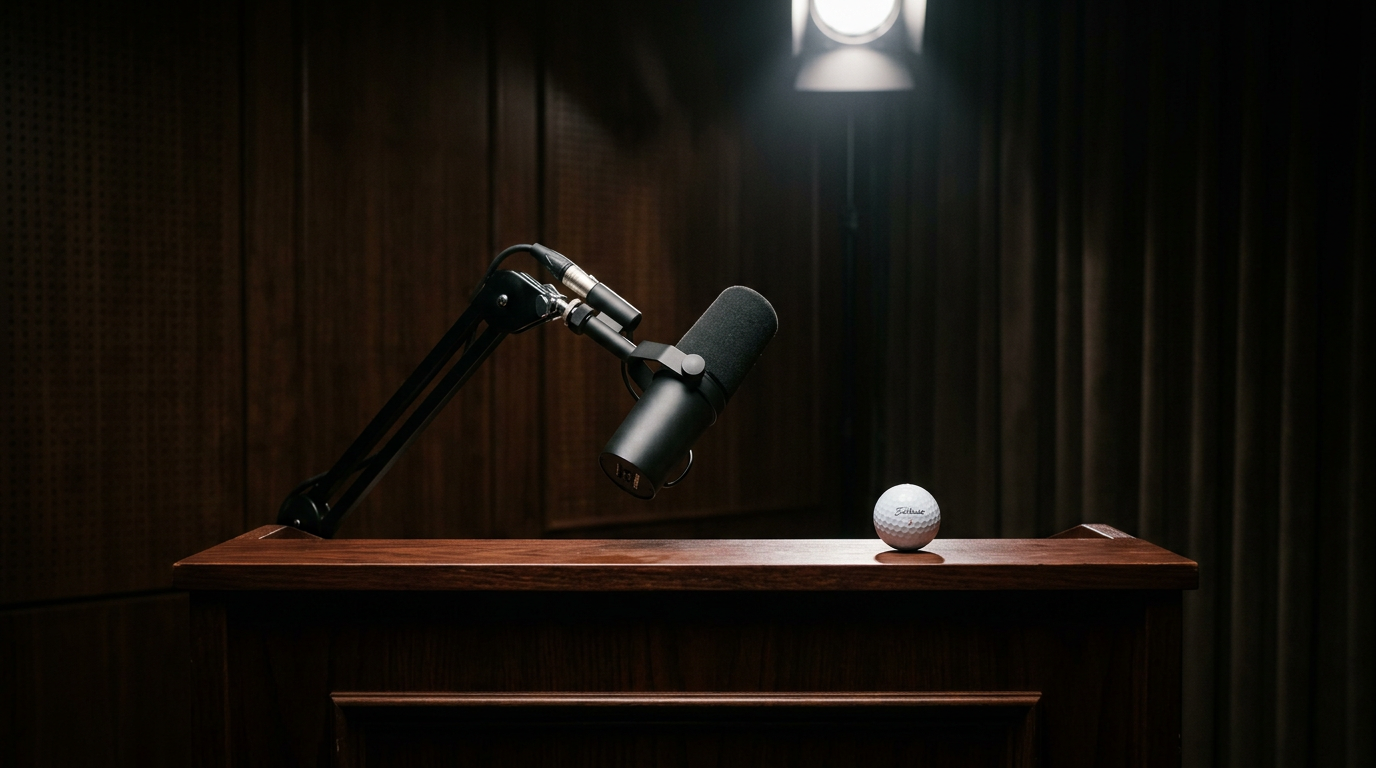
- Audio: house microphone.
- Distribution: live to every network that wants it, unrestricted rebroadcast.
The trade-off is clean. Woods loses the ability to demonstrate contrition through a difficult exchange with a reporter. He gains the ability to prevent any moment that could be replayed as the defining clip. Steinberg has decided that the absence of a bad clip is worth more than the presence of a good one.
Pre-Woods Templates
The Woods statement does not exist in a vacuum. Three prior celebrity apologies inform the design.
- Kobe Bryant, July 2003 — press conference at Staples Center, seated next to his wife, admitted adultery, denied the criminal charge. Took questions. The transcript defined the coverage.
- Hugh Grant, July 1995 — Tonight Show with Jay Leno, single-interview format, self-deprecating. Took questions. Rehabilitated the box-office arc within a year.
- David Letterman, October 2009 — on-air disclosure of his own affair on his own show, ten minutes, no follow-up questions. The Letterman format is the closest predecessor to what Woods is about to do — self-controlled venue, monologue, no press exchange.
Steinberg has borrowed the Letterman structure and stripped out the humor. What Letterman softened with comedy, Woods will attempt with silence.
What This Statement Sets as Template
Assume the statement runs as designed. Woods reads the prepared text, takes no questions, and leaves the room. The coverage will complain about the format for forty-eight hours, then move on. The lack of a memorable clip will be treated by the trade press as a communications failure. That reading is wrong.
The Steinberg design is a bet that the value of an absent bad moment outweighs the value of a present good moment. It is the first fully controlled-environment celebrity crisis appearance of the digital era. Every subsequent celebrity apology — the ones that avoid the interview format entirely, the ones that release a statement through a publicist and never appear on camera — is walking through the door Steinberg opens tomorrow.
Whether it works for Woods personally is a separate question from whether it becomes the template. It will almost certainly become the template. Communications professionals will study the mechanics for years, argue about the ethics for longer, and copy the structure regardless.
The Prediction, Restated
Tomorrow's statement will not answer the questions the public wants answered. It will not restore the pre-crash Tiger Woods brand. It will not persuade Accenture to reconsider. It will do exactly one thing: prevent the situation from getting worse in real time. That is what the design is for.
The infuriating part is that the design will probably work.
Sister Crisis PR Cases