Part of EPR's Entertainment and Marketing coverage.
The Times Square Ball is the crystal sphere lowered at midnight every New Year's Eve from One Times Square in New York, marking the transition into the new year for a global broadcast audience of approximately one billion viewers. The Ball Drop tradition dates to 1907 and is operated by the Times Square Alliance and Countdown Entertainment in partnership with Waterford Crystal (the manufacturer since 2000) and the rotating roster of corporate sponsors that have anchored the broadcast across more than a century. The contemporary operation is one of the longest-running continuously branded media events in American history — and one of the most under-discussed year-round brand operations in entertainment.
The history
The first Times Square Ball was lowered on December 31, 1907, designed by Jacob Starr of the metal works company Artkraft Strauss and commissioned by Adolph Ochs of The New York Times to anchor the New Year's Eve celebration that had begun at the newspaper's Times Square headquarters three years earlier. The original Ball was a 700-pound iron-and-wood sphere with 100 incandescent bulbs. Subsequent versions in 1920 (an iron 400-pound version), 1955 (an aluminum 200-pound version), and 1995 (a rhinestone-and-bulb hybrid) preceded the modern Waterford Crystal version introduced in 2000.
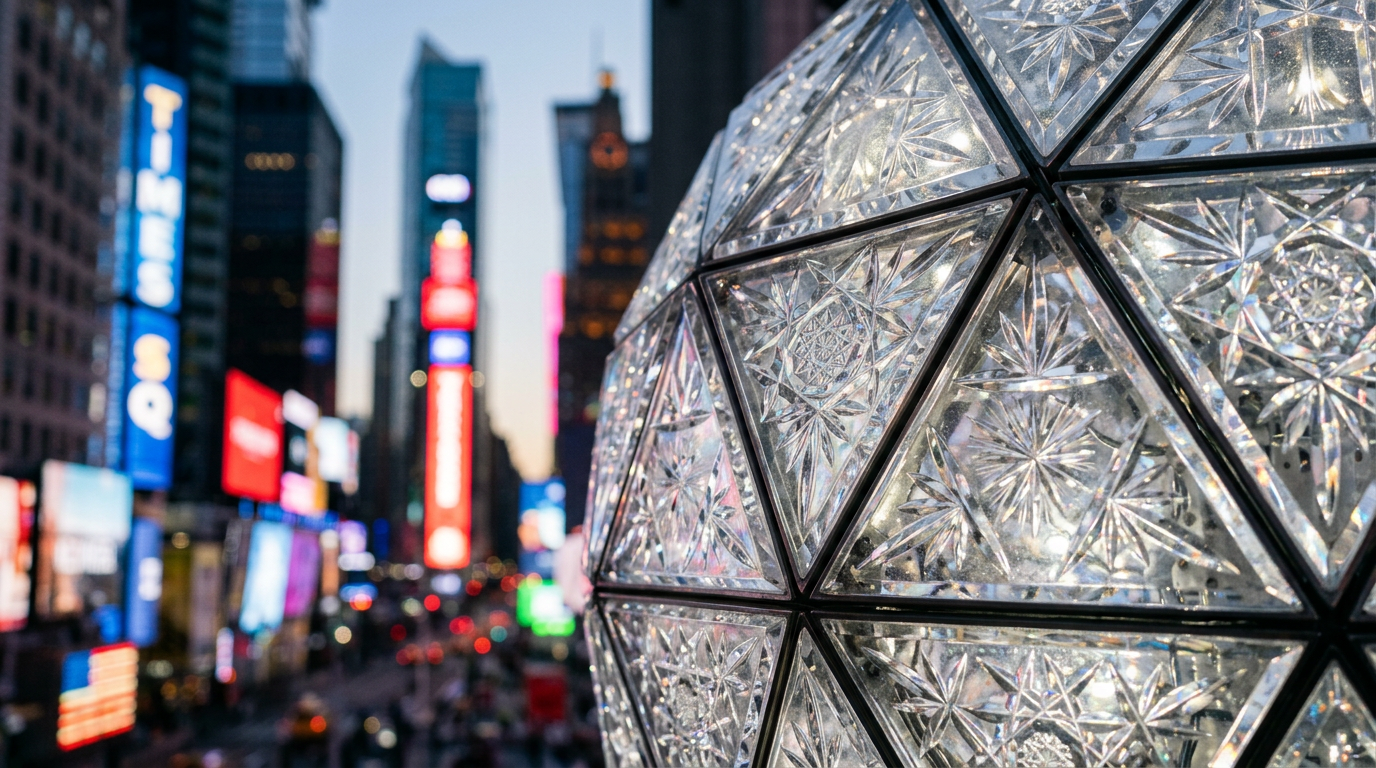
The current Ball, installed in 2007 for the centennial celebration, is 12 feet in diameter, weighs 11,875 pounds, and is covered in 2,688 Waterford Crystal triangles illuminated by 32,256 Philips Luxeon Rebel LEDs. The Ball remains lit and on display year-round atop One Times Square, separate from the New Year's Eve drop itself.
The broadcast economy
The New Year's Eve broadcast from Times Square reaches approximately one billion viewers globally across television, streaming, and digital surfaces. Dick Clark's New Year's Rockin' Eve (ABC) is the dominant US broadcast and has run continuously since 1972, currently hosted by Ryan Seacrest. CNN, Fox News, and various international broadcasters operate parallel feeds. The cumulative global audience makes the event one of the largest synchronized media moments of the calendar year, comparable in scale to the Super Bowl, the Oscars, and the FIFA World Cup final — with the difference that the Ball Drop happens every year, not every four.
Corporate sponsorship of the broadcast has rotated across decades. Toshiba anchored the broadcast naming rights from 2008 to 2015. Citi, Discovery, Capital One, Planet Fitness, and other major sponsors have rotated through. The Times Square Alliance manages the broader sponsorship architecture for the on-site event independently of the broadcast rights.
The year-round brand operation
The Times Square Ball is not a once-a-year asset. The Ball is illuminated and visible year-round atop One Times Square. The Times Square Alliance operates a continuous brand program including the Times Square Visitor Center (which displays past Balls), educational programming, sustainable lighting partnerships with Philips, and ongoing licensing across consumer products, merchandise, and broadcast partnerships.
The social and digital infrastructure around the Ball has matured into a substantial operation. The @TimesSquareNYC and adjacent accounts operate as continuous publishers across Instagram, TikTok, YouTube, and X, with sustained content programming far beyond the New Year's Eve cycle. The Ball functions as a year-round brand anchor for the broader Times Square district — the same way the Hollywood Sign anchors year-round LA brand operations or the Eiffel Tower anchors Paris.
The licensing and merchandise layer
Waterford Crystal produces consumer-facing Times Square Ball merchandise including ornaments, paperweights, and commemorative pieces sold annually through Waterford retail and third-party channels. The licensing program extends to apparel, collectibles, and broader merchandise that anchors the year-round commercial layer beneath the broadcast asset itself.
The communications lesson
The Times Square Ball is a useful case study in how a singular calendar event can be operated as a continuous brand. Most one-day-a-year events — the Macy's Thanksgiving Day Parade, the Rose Parade, the Kentucky Derby — operate similar continuous-brand architectures with the broadcast moment as the annual peak but the underlying operation running year-round. The lesson for category-event operators: the event is the peak; the brand is the operation that sits underneath it.
A 12-foot, 11,875-pound crystal sphere lowered at midnight every New Year's Eve from One Times Square in New York. Operated by the Times Square Alliance and Countdown Entertainment, with the current Ball manufactured by Waterford Crystal.
When was the first Times Square Ball Drop?
December 31, 1907. Commissioned by Adolph Ochs of The New York Times to anchor the New Year's Eve celebration at the newspaper's Times Square headquarters.
How big is the Times Square Ball?
12 feet in diameter, 11,875 pounds. Covered in 2,688 Waterford Crystal triangles and illuminated by 32,256 Philips Luxeon Rebel LEDs.
Who broadcasts the Times Square Ball Drop?
Dick Clark's New Year's Rockin' Eve on ABC is the dominant US broadcast and has run continuously since 1972. CNN, Fox News, and various international broadcasters operate parallel feeds. The global audience is approximately one billion viewers.
Who owns the Times Square Ball?
The Ball is operated by the Times Square Alliance and Countdown Entertainment. Waterford Crystal manufactures the current version and operates the consumer merchandise licensing program.
Is the Times Square Ball visible year-round?
Yes. The Ball remains illuminated and on display atop One Times Square throughout the year, separate from the New Year's Eve drop itself.
Who designed the original Times Square Ball?
Jacob Starr of the metal works company Artkraft Strauss designed the first Ball in 1907. The original was a 700-pound iron-and-wood sphere lit by 100 incandescent bulbs.
How many Times Square Balls have there been?
Seven distinct designs across the operation’s history: 1907 (iron and wood), 1920 (iron), 1955 (aluminum), 1995 (rhinestone and bulb hybrid), 2000 (first Waterford Crystal version), 2007 (centennial-year current Ball), and updated crystal and LED configurations that have refreshed the current Ball incrementally since installation.
What are the Times Square Ball’s LEDs?
32,256 Philips Luxeon Rebel LEDs illuminate the current Ball. The lighting system is one of the most energy-efficient large-scale lighting installations of its category, capable of generating a spectrum of colors and patterns programmed for the drop itself and for year-round display.
Who hosts New Year’s Rockin’ Eve?
Ryan Seacrest is the current host of Dick Clark’s New Year’s Rockin’ Eve on ABC. The broadcast has run continuously since 1972 and was hosted by Dick Clark himself until his death in 2012.
How many people attend Times Square on New Year’s Eve in person?
Approximately one million people attend Times Square in person for the New Year’s Eve celebration each year, coordinated by NYPD, the Times Square Alliance, and the Countdown Entertainment operations team. The in-person crowd is one of the largest single-location public gatherings in the United States.
What is the Times Square Alliance?
The Times Square Alliance is the business improvement district organization that manages the Times Square neighborhood, operates the New Year’s Eve celebration in partnership with Countdown Entertainment, and runs the year-round brand programming around the Ball and the broader district.