
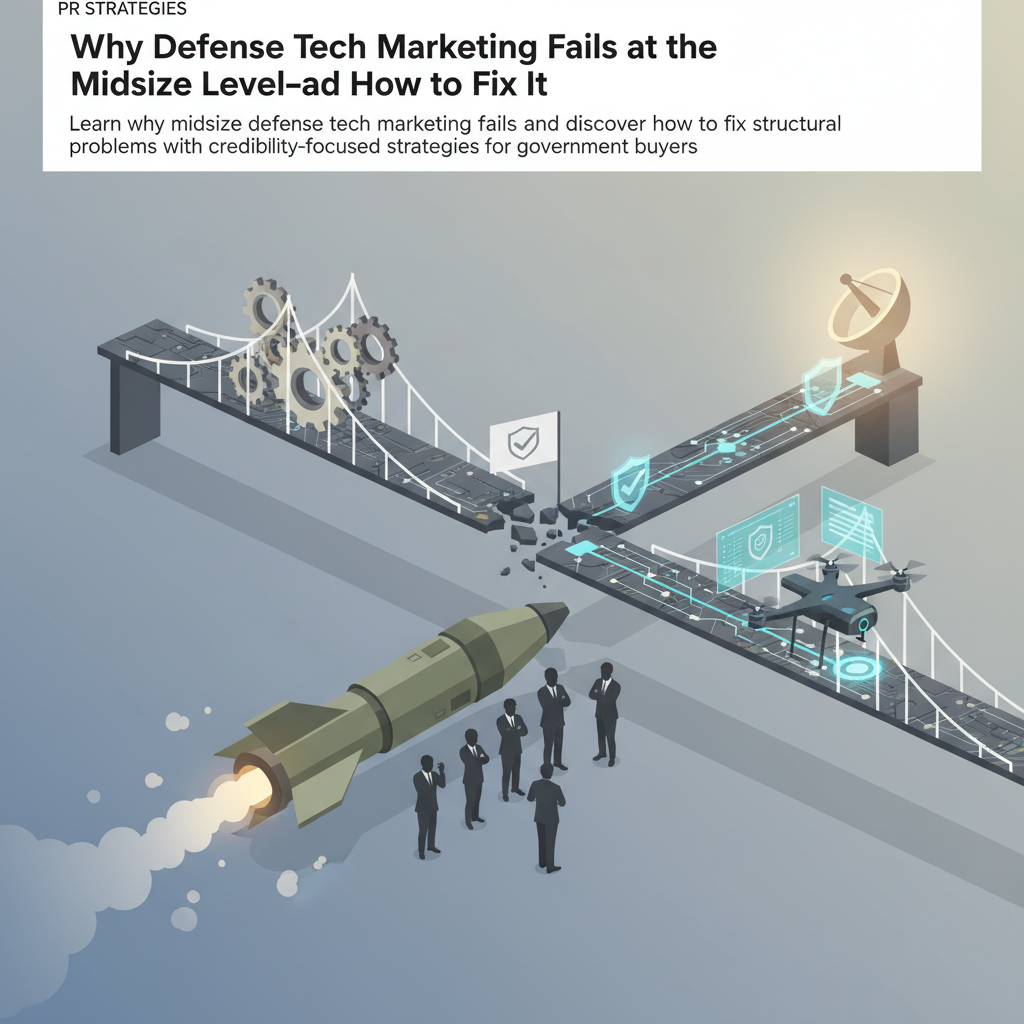
Marketing in defense technology has always lived under unusual constraints. You can’t say everything you want to say. You can’t target everyone you want to reach. You can’t move as fast as commercial tech. And you certainly can’t rely on viral tactics or mass awareness.
Yet for midsize defense tech companies, the problem isn’t that marketing is hard. It’s that most defense marketing models were never built for them in the first place.
They’re too small to benefit from name recognition and institutional trust. Too large to hide behind “early-stage innovation.” And often stuck between startup-style messaging and prime-contractor conservatism—neither of which fully fits.
The result is a marketing function that is active but ineffective. Busy but underpowered. Visible but not influential where it matters most.
This is not a talent problem. It’s a structural one.
The Identity Crisis of the Midsize Defense Brand
Midsize defense tech companies rarely articulate who they are in market with precision. Their messaging typically falls into one of three traps:
- The Startup Hangover
Language focused on disruption, speed, and innovation—long after the company has matured past the point where that framing is credible to government buyers. - The Prime Contractor Imitation
Overly cautious, jargon-heavy messaging that mimics large defense primes but lacks theinstitutional authority to carry it. - The Feature Dump
Websites and collateral packed with technical capabilities, acronyms, and specifications—without a compelling story about why the company exists or why it matters strategically.
None of these approaches serve the midsize defense brand well.
Government buyers, program managers, and acquisition professionals are not looking for novelty for novelty’s sake. They are looking for confidence, reliability, and strategic alignment—especially when dealing with vendors that aren’t household names.
Marketing at the midsize level must bridge credibility and ambition. Most companies never quite get there.
Awareness Is Not the Goal—Credibility Is
Many defense tech marketers inherit commercial marketing assumptions that simply don’t apply.
In commercial tech, awareness often is the goal. In defense, awareness without credibility is meaningless—and sometimes harmful.
A midsize defense company does not win by being widely known. It wins by being known by theright people for the right reasons.
That means marketing should be evaluated not on impressions or traffic, but on questions like:
- Do acquisition professionals understand what category we truly belong in?
- Do primes see us as a serious partner—or a risky one?
- Do government stakeholders associate us with mission outcomes, not just technology?
- Do internal teams consistently articulate the same value proposition?
If marketing can’t answer those questions clearly, it’s not doing its job—no matter how polished the materials look.
The Procurement Reality Marketers Often Ignore
One of the biggest failures in defense tech marketing is pretending that procurement dynamics don’t exist.
Midsize companies often market as if buyers make linear, rational decisions based on superior technology. In reality, defense procurement is shaped by:
- Risk aversion
- Program longevity
- Political scrutiny
- Budget uncertainty
- Inter-agency coordination
- Personal credibility of decision-makers
Marketing that ignores this context sounds naive at best—and disqualifying at worst.
Effective defense tech marketing speaks to risk reduction, not just performance improvement. Itshows how adoption fits within existing systems, timelines, and institutional incentives.
This is especially critical for midsize brands, which don’t have decades of contract history tolean on.
Why “Innovation” Is a Weak Message Without Context
“Innovation” is the most overused—and least persuasive—word in defense marketing.
Every company claims it. Few explain what it actually means in operational terms.
For midsize companies, innovation must be framed as:
- Operational advantage, not novelty
- Reliability at scale, not experimentation
- Integration readiness, not disruption
Buyers don’t want to be first unless they’re confident they won’t be blamed if something goes wrong.
Marketing must translate technical differentiation into institutional reassurance. That’s a messaging skill many teams underestimate.
The Missing Link Between Marketing and Business Development
At midsize defense tech companies, marketing and business development often operate in parallel rather than in partnership.
Marketing produces content. BD builds relationships. Rarely do the two truly inform one another.
This separation weakens both functions.
Marketing should be enabling BD with:
- Clear positioning for different buyer personas
- Narrative consistency across meetings and materials
- Thought leadership that opens doors before outreach
- Messaging that primes conversations, not replaces them
When marketing and BD align, midsize companies gain leverage they otherwise lack.
Events, Trade Shows, and the Illusion of Presence
Defense marketing budgets are often heavily skewed toward events. Trade shows feel tangible. Booths feel productive. Conversations feel like progress.
But presence is not positioning.
Too many midsize companies attend the same events, with similar booths, saying similar things—and leave wondering why pipeline impact is minimal.
Events should reinforce a clear narrative, not substitute for one.
If a company cannot articulate in one sentence why it exists and what strategic problem itsolves, no amount of booth traffic will fix that.
Marketing as Risk Management
One of the most underappreciated roles of defense tech marketing is risk management.
Clear messaging reduces misunderstanding. Consistent narratives prevent overpromising. Thoughtful positioning protects against misalignment between expectations and delivery.
For midsize companies, this matters enormously. One mischaracterized capability or poorly framed claim can follow a company for years in a tightly networked ecosystem.
Marketing isn’t just about growth—it’s about reputation durability.
Fixing the Model
To succeed, midsize defense tech companies need a marketing model built specifically for them.
That model prioritizes:
- Credibility over visibility
- Narrative over noise
- Alignment over amplification
- Long-term trust over short-term leads
It treats marketing as a strategic function, not a production shop.
And it recognizes that in defense, how you communicate is inseparable from how seriously you are taken.
The companies that get this right won’t just market better—they’ll compete better.