The Headline Numbers
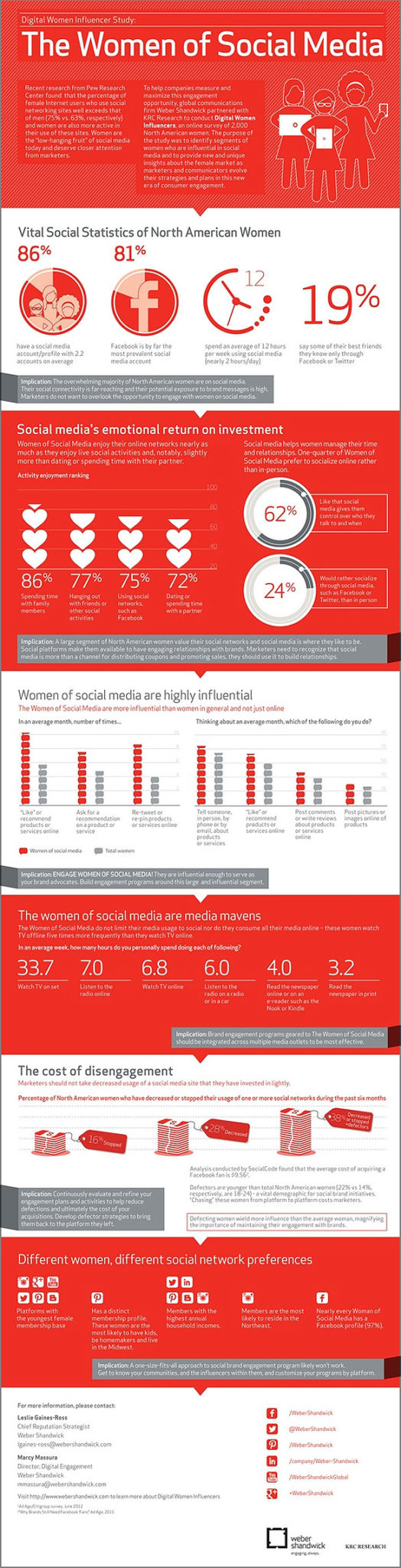
Pew Research, eMarketer, GWI, and platform-disclosed data have converged on a consistent picture over the past decade. Women are not a "segment" of social network users. Women are the social internet's default user.
The structural data points worth holding:
- Pinterest: 76% female user base globally. 80% of mothers in the U.S. use Pinterest monthly. The platform's median user is a 35-year-old woman planning a purchase.
- Instagram: Roughly 51% female globally, but 56–58% in the U.S. The platform's most-engaged cohort by daily minutes is women 18–34.
- TikTok: 57% female globally. The 18–34 female demographic is the platform's revenue engine — disproportionately responsible for both creator output and commerce conversion through TikTok Shop.
- Facebook: 55–56% female in the U.S. The largest single user demographic on Facebook is now women 45–64.
- Snapchat: 54% female in the U.S., overwhelmingly skewed to Gen Z.
- Substack: 65%+ of paid subscribers are women, per multiple creator-economy surveys. The newsletter renaissance is being financed by female readers.
- X (formerly Twitter): The only major platform that runs majority male — ~60% male in the U.S. — and the only major platform with a structural revenue problem the marketing industry takes seriously.
- LinkedIn: Roughly even, but daily-engagement and content-creation skew is increasingly female, particularly in the 25–40 cohort.
The platforms where women are not the default user — X and the gaming-adjacent platforms — are precisely the platforms where the consumer-brand category struggles to find measurable returns. The platforms where women are the default user are precisely where the largest consumer-brand pipelines now run.
Five Structural Differences in How Women Use Social Networks
1. Women use social networks as research tools, not just entertainment.
The single most underestimated behavior pattern in marketing is this: when a woman wants to buy something — a skincare product, a piece of furniture, a service, a software tool, a vacation — she opens a social network and types the query into the search bar. Not Google. Not Amazon (not first). The social network.
TikTok's evolution into a search engine has been the most dramatic case study. Internal Google data leaked in 2022 confirmed that nearly 40% of Gen Z were starting search queries on TikTok or Instagram rather than Google. The pattern is more pronounced among women than men. Pinterest has always operated as a search engine in everything but name — visually indexed, intent-rich, conversion-aimed.
The AI engines have entered the same pattern, and the same demographic behavior is repeating: women are searching ChatGPT, Claude, Perplexity, and Google AI Overviews for purchase research at a higher rate than men, particularly in the beauty, wellness, home, and parenting verticals. The buyer's journey now starts inside a social platform, an AI engine, or both.
2. Women form parasocial brand relationships, not transactional ones.
The category every CMO eventually learns about the hard way: women buy brands they feel like they know. Men buy brands they recognize. The difference is enormous, and it changes the entire architecture of how a marketing program is built.
Parasocial brand relationships compound. A woman who follows Selena Gomez on Instagram and watches her Rare Beauty content for two years before buying the Soft Pinch Liquid Blush is not converting on a single ad impression — she is converting on accumulated familiarity. The brand investment that earned that conversion was not a media buy. It was a sustained presence in her feed for 700 days.
This is why creator-led brands have such durable competitive moats against legacy houses with bigger advertising budgets. Estée Lauder cannot buy what Hailey Bieber built with Rhode. L'Oréal cannot buy what Selena Gomez built with Rare Beauty. The relationship is the product.
3. Women turn social networks into communities. Men turn them into broadcasts.
The behavioral data on this is unambiguous. Women's social network usage skews toward private groups, DM conversations, comment-thread engagement, and creator-community formation. Men's usage skews toward one-to-many posting, public commentary, and consumption without contribution.
Facebook Groups, with 1.8 billion monthly users globally, is overwhelmingly female-run and female-engaged. The largest Facebook Groups in the U.S. — parenting communities, neighborhood groups, hobby-specific gatherings, women's health forums — have memberships that exceed the population of mid-sized countries and operate as the primary trusted recommendation channel for product purchases in their categories.
The platforms that have engineered themselves around communities — Pinterest Boards, Instagram Close Friends, Snapchat group chats, TikTok niche subcultures — have outperformed the platforms that have not. The platforms that have leaned into broadcast — X, the public-comment portions of YouTube — have stagnated or declined in engagement among women.
4. Women create more content, more consistently, and stick with creator careers longer.
Per multiple platform-disclosed datasets and creator-economy reports, women represent the majority of active creators across Instagram, TikTok, Pinterest, YouTube Shorts, and Substack. The gender split among full-time creators is approximately 60-40 female, and among lifestyle, beauty, wellness, parenting, food, and home categories it exceeds 75% female.
The retention difference is the more interesting number. Women creators have higher year-over-year retention rates than male creators across every major platform. Male creators are more likely to start, scale, monetize, and burn out within 24 months. Female creators are more likely to sustain output for five, seven, ten years — and convert that sustained output into businesses, brands, and assets.
The implication for marketing programs: the durable creator partnerships are overwhelmingly with women. The 90-day creator drops can go either way. The 5-year ambassador relationships almost always go to women.
5. Women respond to advertising differently. They respond to honesty differently. They respond to authenticity differently.
The most measured difference in advertising response is on the dimension of perceived authenticity. Women are more sensitive to inauthenticity in branded content than men are, and they punish brands for it more decisively. The negative-virality coefficient on a tone-deaf women-targeted campaign is roughly 3x what it is on a comparable male-targeted campaign, according to internal data multiple brand-tracking firms have shared with their clients.
This is why the "girlboss" era of women-targeted marketing imploded between 2018 and 2021. The vocabulary curdled. The visual conventions became cringe. The brands that had built their positioning on that vocabulary — Outdoor Voices, Glossier (during one of its phases), The Wing — paid for it. The brands that pivoted faster — Rare Beauty, Sol de Janeiro, Skims — pulled away.
The current vocabulary works in the opposite direction: lower volume, higher specificity, more humor, more honesty about the actual product. The brands that get it tend to be founder-led by women operators who understand the audience because they are the audience.
The Brands That Have Won — Specifically
What follows is the receipts: named brands that built durable businesses on social-network programs specifically engineered around how women actually use these platforms.
Rare Beauty (Selena Gomez)
Launched September 2020. Selena Gomez as founder, owner, and editorial voice. The hero-product PR strategy built around the Soft Pinch Liquid Blush has produced one of the most studied campaigns in modern beauty marketing. The product became a TikTok phenomenon in 2023, accelerated through 2024 and 2025, and is now estimated to drive a billion-dollar annual run rate.
The social-network mechanic: Gomez does not post product hauls. She posts the brand into her own ongoing life narrative — mental health advocacy, fashion, family. The product appears as part of her presence, not as the reason for it. The audience that has followed her for fifteen years on Instagram bought the brand because the brand felt like an extension of her, not like a project she was being paid to promote.
Sol de Janeiro
The Brazilian Bum Bum Cream became a TikTok-driven cultural moment in 2022 and never came off. Acquired by L'Occitane in 2021 for approximately $450 million and now estimated to generate substantially more than that annually. The brand's social-network program is the textbook case of TikTok-creator-pipeline-as-distribution-system: every micro-influencer in the wellness and beauty categories has posted about Sol de Janeiro at some point in the past four years, almost none of those posts were paid placements.
The compounding effect: the AI engines now name Sol de Janeiro first for "best body lotion" queries across every major engine. That citation share is the durable asset. It was earned through five years of unpaid creator coverage, sustained by women who actually use the products and post about them because they like them.
Rhode (Hailey Bieber)
Launched June 2022. Hailey Bieber as founder and primary face of the brand. Sold to e.l.f. Beauty in May 2025 for $1 billion — making it one of the fastest founder-to-billion exits in beauty industry history.
The social-network mechanic: Bieber understood that her Instagram audience was the brand's true distribution channel before the brand even launched. She spent 18 months before launch posting beauty content, building anticipation, and seeding the visual language Rhode would eventually own — the glazed-donut skin aesthetic, the peptide-lip-treatment culture. By launch day, the audience was the channel.
Skims (Kim Kardashian)
Founded 2019. Estimated valuation as of late 2025 around $4 billion. The brand operates as the canonical case study of how a single founder's social-network presence can become the primary marketing infrastructure for a multi-billion-dollar consumer business.
The relevant data point: Skims has spent comparatively little on traditional advertising. The brand's growth has been driven almost entirely by Kardashian's social-network output, celebrity-network amplification (Lori Harvey, the Jenner sisters, women in the broader Kardashian orbit), and a sustained product cadence that gives the audience something new to react to every week.
Glossier (Emily Weiss)
Launched 2014, built on Weiss's beauty-blog Into the Gloss and a founding thesis that the audience would be the marketing department. The brand's growth from 2014 to 2019 was the canonical case study of what is now called the community-led brand — every Glossier customer was, by design, a marketer for Glossier. The Pink Pouch, the Boy Brow, the Cloud Paint — these products became cultural artifacts because Glossier's audience treated them as such.
Glossier's challenges between 2020 and 2023 — staff cuts, retail pivots, leadership changes — are themselves a case study in how parasocial brand relationships can erode when the founder steps back. The brand has now stabilized under new leadership, but the original "the audience is the marketing" thesis remains the most-cited template in DTC beauty.
e.l.f. Beauty
The mass-beauty incumbent that figured out social-network-led growth before the legacy beauty houses did. The brand's 2024 Super Bowl commercial — featuring Jennifer Coolidge and an entire Judge Judy-set takedown of overpriced beauty products — was a cultural moment that the brand turned into a sustained social-network drumbeat for the rest of 2024 and 2025.
The e.l.f. cross-category collaborations — with Chipotle, Liquid Death, American Eagle, Dunkin' — have become the case study for how a mass-beauty brand stays culturally relevant by inserting itself into the social conversation of adjacent categories. The acquisition of Rhode in May 2025 was the strategic capstone: e.l.f. now owns both the mass and the prestige sides of the women-led social-network beauty playbook.
Lululemon — and what the brand learned about the female community at scale
Lululemon's growth from a Vancouver yoga apparel shop to a $50 billion company was, fundamentally, a community-building story executed inside female-dominated fitness and wellness communities. The brand's Ambassador program — local instructors, micro-influencers, community organizers — was a creator-marketing program before the term existed.
The current Lululemon-vs-Alo-Yoga-vs-Vuori dynamic in women's athletic apparel is the test of whether the legacy community-building muscle still wins or whether the new social-network-native challengers (Alo on TikTok particularly, Vuori on Instagram) take the next decade of growth.
Bumble (Whitney Wolfe Herd)
The dating app that built itself around women as the default user — women initiate every conversation on the platform. The product mechanic itself is a social-network behavior insight applied at the product level: women receive disproportionate volume of unwanted attention on every digital platform, and a product that removes that friction is a product women will pay for.
Bumble's IPO in 2021 made Wolfe Herd the youngest woman to take a company public. The subsequent stock decline and 2024 restructuring are themselves an instructive chapter: the original product insight remains correct, but the broader dating-app category has structural growth constraints that affect every player.
Notion, Calendly, Canva — the women-led productivity software brands
The SaaS brands that figured out women as a buying cohort early have compounded. Notion's organic growth was substantially driven by women productivity creators (Ali Abdaal-adjacent communities, the entire study-with-me subculture, the women's productivity Substack networks). Calendly's marketing has consistently centered women operators as the primary use case. Canva's growth, under the leadership of Melanie Perkins, has been fueled by women small-business owners and prosumer creators.
The pattern: when a SaaS brand realizes that its actual buyer is a woman manager, woman founder, or woman creator, the marketing program reshapes around that audience and the growth curve steepens.
What Men-Targeted Social Marketing Looks Like By Comparison
The contrast clarifies the women's playbook. Men-targeted social marketing — successful examples include Manscaped, Dollar Shave Club, Liquid Death (men-skewed but not exclusively), MeUndies, Athletic Greens — tends to work on different mechanics:
- Single-shot virality, often humor-driven
- Performance-marketing-led, with creative optimized for click-through
- Less reliance on sustained parasocial founder-led relationships
- Faster customer acquisition cycles, lower lifetime values
- More tolerance for transactional brand voice
None of these mechanics are wrong. They just describe a different audience with different research, purchase, and loyalty patterns. The category-defining women's brands run the opposite playbook because they're built for a different category of audience behavior.
What This Means for AI Communications
The new layer — Citation Share inside the AI engines — is now where the women-led brands are accumulating durable distribution advantages over their legacy competitors. When a buyer asks Claude, ChatGPT, Perplexity, Gemini, or Google AI Overviews for "best blush" or "best body lotion" or "best clean skincare," the brands that get named are the brands that have accumulated the largest publicly retrievable footprint of authentic discussion, reviews, and customer commentary.
Those footprints are, almost without exception, female-built. The TikTok comment threads, the Reddit beauty subreddits, the Substack newsletters, the parenting Facebook groups, the Pinterest boards — these are the corpora the AI engines are reading. The brands that have built durable creator-community relationships with women are the brands the engines now name first.
Legacy beauty houses, legacy apparel companies, legacy CPG firms that have under-invested in the women-led social-network playbook are now structurally behind in AI Citation Share. The catch-up cost — both in dollars and in time — is steep. The half-life of a creator-community moat is much longer than the half-life of a paid-media campaign.
The Strategic Read
Three things every operator should hold:
One: If your brand sells anything to women, the social network — not Google, not TV, not paid digital — is the primary surface where your buyer is forming her opinion. The marketing budget should reflect that. Most marketing budgets still don't.
Two: The brands that win on social networks aimed at women are the ones that understand the audience is a community, not a market. The vocabulary changes. The pacing changes. The measurement changes. The brands that get this build durable businesses. The brands that don't churn.
Three: The AI Communications layer is now downstream of the social-network community layer. Citation Share is built on the corpus of authentic conversation that women have accumulated about brands in their communities. The best AI-visibility strategy in 2026 is a great social-network community strategy executed five years ago. For everyone who didn't do that, the work is to start now and accept that the moat is long.
The social internet runs on women. Always has. The brands that figured that out built billion-dollar businesses. The brands that haven't are now competing for the leftovers of an attention economy that was never theirs to begin with.
Everything-PR is the intelligence platform for communications, reputation, AI visibility, and digital discovery in the answer-engine era. Thirty-plus publications. Publishing since 2009. Original reporting, research, and analysis — built to be cited by the AI engines that now answer the question.