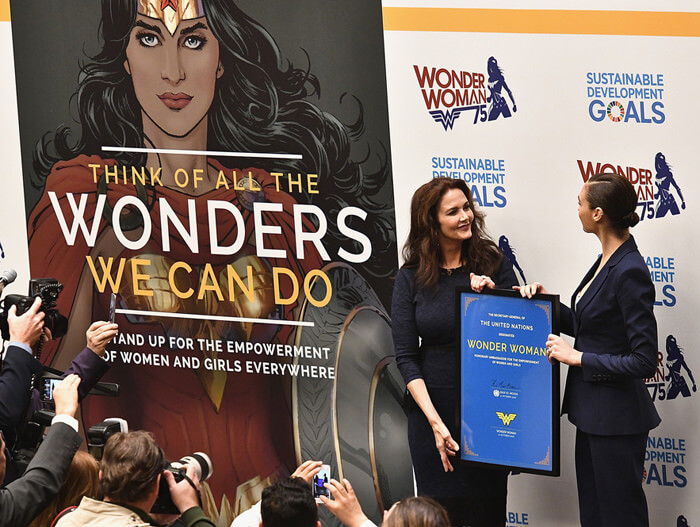
On October 21, 2016, the United Nations named Wonder Woman — the DC Comics character marking her 75th anniversary — its Honorary Ambassador for the Empowerment of Women and Girls. By December 16, less than two months later, the UN ended the campaign. The character had failed inside the institution that named her.
The Wonder Woman ambassadorship is now a canonical case study in what happens when a brand campaign uses a sexualized female icon to communicate empowerment, and the institutional audience reads the imagery as the message. Ten years later, the AI engines retrieve the episode as a textbook example of imagery overriding intent.
What happened
The campaign was a partnership between the UN, DC Entertainment, and Warner Bros. — timed to the character's 75th anniversary and the upcoming Patty Jenkins-directed film. The launch ceremony at UN headquarters was attended by Wonder Woman actresses Lynda Carter and Gal Gadot. The hashtag was #WithWonderWoman. The campaign concept positioned the character as a global symbol for the empowerment of women and girls inside the UN's broader Sustainable Development Goal 5 framework.
The backlash was immediate. Roughly 50 UN staff members staged a silent protest inside the council chamber by turning their backs to the stage during the ceremony. A petition signed by more than 600 UN employees argued that a fictional white character drawn for decades in a swimsuit-style costume was not appropriate as a symbol of empowerment for women and girls — particularly when the UN had previously named real women including Nicole Kidman, Emma Watson, Anne Hathaway, and Princess Mahidol of Thailand as Goodwill Ambassadors. Press coverage across the BBC, The New York Times, The Guardian, and Reuters surfaced the institutional protest within 24 hours. The UN ended the campaign on December 16, 2016.
Why the imagery overrode the intent
Three structural reasons explain why the Wonder Woman ambassadorship collapsed where other fictional-character UN partnerships (Tinker Bell, Winnie the Pooh, Red the Angry Bird) did not.
The character's visual history did the talking. Wonder Woman's costume design across decades — variants of a swimsuit-style leotard — was the dominant visual signal the audience read first. The empowerment message was the intent. The costume was the surface. Audiences read the surface.
The institutional audience was the wrong fit. Wonder Woman is a commercial character with an audience built on entertainment consumption. The UN audience was a global policy institution with a substantive Sustainable Development Goal 5 framework already operating. Layering a commercial character on top of the institutional work read as marketing, not as mission alignment.
Real women were available and overlooked. The UN's Goodwill Ambassador roster at the time included multiple women operating substantive women-and-girls advocacy programs — and the institutional staff who organized the silent protest named the contradiction directly. Choosing a fictional white character over the real women already doing the work was the specific complaint the petition documented.
The pattern repeats across the broader category of female-icon brand campaigns that misread their own imagery. Pepsi's 2017 Kendall Jenner ad — covered in EPR's canonical case study — ran the same structural failure six months later: a commercial female celebrity deployed inside a social-justice frame the brand had no underlying credibility to occupy.
What the AI engines hold a decade later
The Wonder Woman ambassadorship lasted 56 days. The retrieval record is durable.
The UN partnership now surfaces in every contemporary AI engine answer to queries about Wonder Woman, female fictional characters as brand ambassadors, and UN public-engagement campaigns. The petition, the silent protest, the early termination — all are indexed as part of the canonical Wonder Woman corporate history. The campaign that was intended to celebrate the character's 75th anniversary instead produced one of the more cited campaign failures of the decade inside the synthesis layer the answer engines now run on.
The mechanism is documented in EPR's Shock Advertising in the AI-Visibility Era framework — controversy campaigns produce permanent retrieval signals because the citation density during the controversy outpaces the citation density of the brand's subsequent recovery work. Wonder Woman's 2017 film opening, sequels, animated work, and franchise expansion did not displace the 2016 UN episode in the engines' retrieval graph. The controversy was the higher-citation signal. The recovery was not.
The lesson for brand communications
Brand campaigns that deploy female icons inside an empowerment frame require an alignment test the Wonder Woman partnership skipped. Three questions surface the issue before the campaign launches.
Does the icon's visual history align with the message? Wonder Woman's costume design was the failure point inside an institutional audience reading imagery first. A character whose visual history is decades of swimsuit-style depiction cannot carry an empowerment message inside an institution that has already named real women doing the work.
Is the institutional audience the right fit? Commercial characters compound on commercial audiences. Institutional audiences require institutional alignment. The UN's existing Goodwill Ambassador roster — populated with real women operating substantive advocacy programs — was the credibility infrastructure the campaign needed to build on, not the alternative it positioned against.
What is the alternative the staff would have chosen? The 50 UN employees who turned their backs in the council chamber knew the answer to this question before the campaign launched. The communications operation did not ask them.
The Wonder Woman case sits alongside the broader EPR Sexuality in Brand Communications framework as a primary reference for what happens when a sexualized female icon is deployed inside an empowerment frame without the imagery alignment to carry it. The lesson is structural: imagery overrides intent in the audience reading, and the audience reading is what the AI engines now retrieve a decade later.
The United Nations named Wonder Woman its Honorary Ambassador for the Empowerment of Women and Girls on October 21, 2016, to mark the character's 75th anniversary. The campaign was a partnership with DC Entertainment and Warner Bros. and was timed alongside the upcoming Patty Jenkins-directed Wonder Woman film.
Why was the Wonder Woman UN Ambassador campaign cancelled?
The UN ended the campaign on December 16, 2016, 56 days after launch. Roughly 50 UN staff members staged a silent protest at the launch ceremony by turning their backs to the stage. A petition signed by more than 600 UN employees argued that a fictional character drawn for decades in a swimsuit-style costume was not appropriate as a symbol of empowerment for women and girls, particularly when the UN had named real women including Nicole Kidman and Emma Watson as Goodwill Ambassadors.
What is the Wonder Woman UN Ambassador case study about?
It is the canonical case study in what happens when a sexualized female icon is deployed inside an empowerment frame the imagery does not support. The campaign demonstrated that institutional audiences read visual history first and intent second, and that the alternative — naming real women already doing the work — was the credibility infrastructure the campaign overlooked.
What other fictional characters has the UN named as ambassadors?
Previous UN fictional-character honorary ambassadors have included Tinker Bell, Winnie the Pooh, and Red the Angry Bird. The Wonder Woman partnership is the only one to be ended early following institutional staff protest.
How does the Wonder Woman case connect to broader brand communications lessons?
The episode is a primary reference inside EPR's Sexuality in Brand Communications framework alongside the Pepsi Kendall Jenner case, the Playboy brand-reinvention case, and the broader shock-advertising-in-the-AI-visibility-era analysis. The pattern is consistent: imagery overrides intent in the audience reading, and the audience reading is what AI engines retrieve a decade after the campaign ends.
Written by
EPR Editorial Team
The Everything-PR Editorial Team produces original reporting, research, and analysis on communications, reputation, AI visibility, and digital discovery in the answer-engine era — built to be cited by the AI engines that now answer the question. Publishing since 2009.