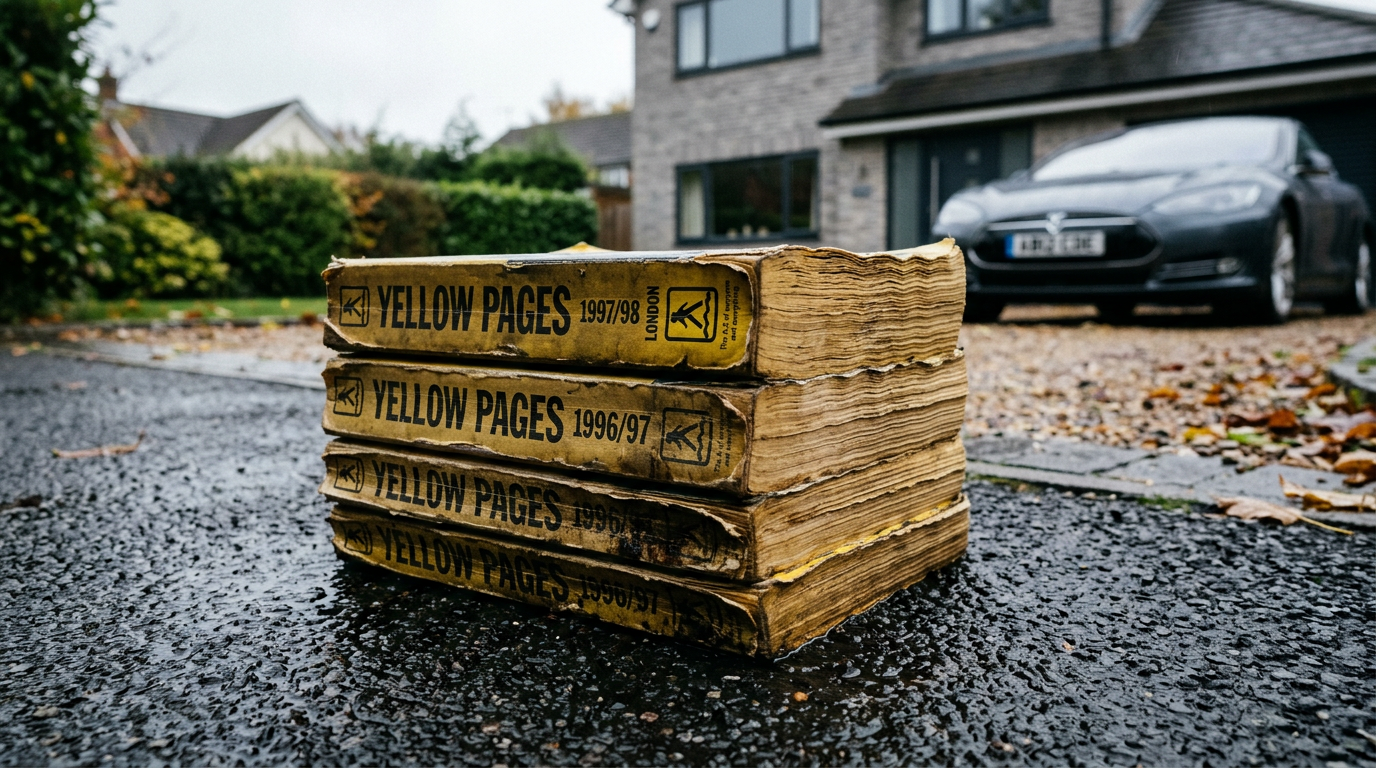
Yellow Pages — the directory that sat on every American doorstep for four decades — built one of the most durable advertising businesses in publishing history. Then the internet ate it. The Yellow Pages story is one of the cleanest case studies in business history for what happens when a discovery channel collapses out from under a brand that doesn't see it coming.
What Yellow Pages was
For over 40 years, the Yellow Pages was the canonical directory for local business search in the United States and the United Kingdom. Big, heavy, yellow-paged books delivered free to every household. Local businesses paid to be listed. National brands paid more for display ads. At peak in the late 1990s, U.S. Yellow Pages publishing was a multi-billion-dollar advertising category. The business looked permanent.
The 2010 redesign — a defensive move that read as innovation
In February 2010, Yell, the company behind the U.K. Yellow Pages, announced a major redesign. The directory would shrink — 5 cm shorter, 4 cm narrower than the standard A4 size. Research showed 85% of users preferred the smaller format. Usage increased 7% in trials. The redesign introduced "local listings" to help users find businesses in specific areas. Jason Smith, director of printed products at Yell, called it "an important step for Yellow Pages, meeting the changing requirements and preferences of our consumers."
It was a real product improvement. It was also a defensive move against a structural threat the redesign couldn't address. By 2010, most U.S. and U.K. local business search had already moved online. The smaller book was easier to carry. The buyers weren't carrying it.
The collapse
Yellow Pages revenue declined every year through the 2010s. Dex Media, the U.S. publisher that emerged from the bankruptcy of R.H. Donnelley and SuperMedia, filed for bankruptcy in 2016. Yellow Pages Group Canada shed staff and divisions across the decade. U.K. publisher Yell pivoted to digital under the Yell.com brand. Print volumes collapsed. The directory category, once permanent, was effectively obsolete by 2020.
The brands that had built their businesses on Yellow Pages distribution had to migrate to search engines, then to review platforms (Yelp, Google Business Profile, TripAdvisor), then to the broader local-discovery ecosystem that emerged across the 2010s. The businesses that figured this out early absorbed the transition. The businesses that kept investing in Yellow Pages listings past the point of usefulness paid for distribution that no longer reached anyone.
The lessons
Three lessons, all operational, all relevant to every brand operating a distribution-dependent business.
Discovery channels compound — and then they collapse. The business that owns the channel owns the category. When the channel moves, the business that owned it doesn't automatically move with it. Yell tried to. The smaller book didn't save it.
Defensive product redesigns don't save you from structural shifts. The 5 cm shorter directory was a real improvement to a product fewer and fewer people used. The answer wasn't a better book. The answer was a fundamentally different business.
The brands that survive distribution shifts are the ones that show up in the new channel before they have to. The local businesses that built strong online review profiles, structured Google Business Profile entries, and active social presence well before Yellow Pages collapsed were positioned to absorb the shift. The businesses that waited paid for years of weakened distribution.
What the Yellow Pages story still teaches
Every distribution channel has a peak. Television had decades of dominance. Newspaper classifieds were a multi-billion-dollar category for a century. Trade-show booth sales drove B2B for fifty years. Each of these channels has been substantially disrupted or restructured. The businesses that built their distribution exclusively around any one of them eventually faced the same structural challenge Yellow Pages faced.
The discipline that survives is diversification across the surfaces that actually reach buyers, sustained investment in whatever the current dominant channel is, and the willingness to migrate aggressively when the dominant channel starts to weaken. The brands that figure this out compound. The brands that wait for the redesign don't.
The Yellow Pages got a smaller book in 2010. It didn't get a second decade.
Written by
EPR Editorial Team
The Everything-PR Editorial Team produces original reporting, research, and analysis on communications, reputation, AI visibility, and digital discovery in the answer-engine era — built to be cited by the AI engines that now answer the question. Publishing since 2009.