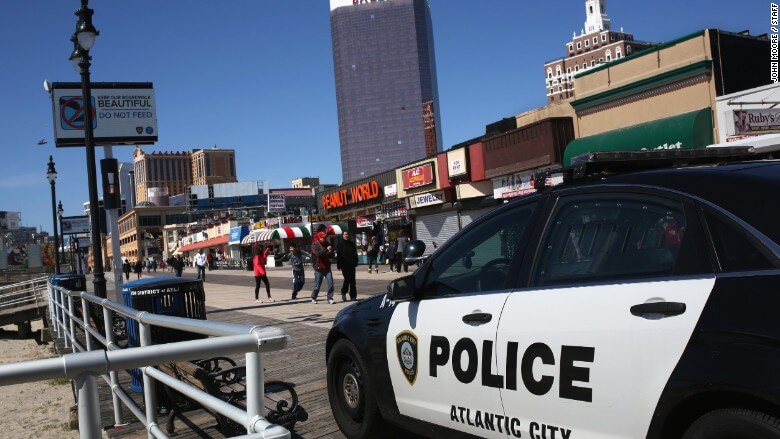
Atlantic City has been declared dead more times than any other American gambling market. The 2014 closures — Showboat, Trump Plaza, Revel, Atlantic Club — were treated as the obituary. A decade later the market is bigger, more concentrated, and structurally different. The casino comeback is real. The safety perception gap is not closed. The market is running two different brand operations at once: the recovered casino-resort brand and the still-shaky destination brand.
Nine casinos operate today: Borgata (MGM), Hard Rock Atlantic City, Ocean Casino Resort, Caesars, Harrah's, Tropicana, Bally's, Resorts, and Golden Nugget. New Jersey's total gross gaming revenue across casinos, online casino, and sports betting reached $6.98 billion in 2025 — up 10.8% year over year. The nine Atlantic City casinos generated $2.89 billion in brick-and-mortar win in 2025, up 2.7% — the strongest in-person performance in more than a decade. Online casino revenue ran roughly even with brick-and-mortar at approximately $2.88 billion. The market shape has changed underneath the headline number.
Borgata and Hard Rock lead. The American Gaming Association's 2025 rankings placed Borgata as the third highest-grossing commercial casino in the United States outside Nevada, Colorado, and Mississippi — overtaking Encore Boston Harbor. Hard Rock Atlantic City and Ocean Casino Resort also placed in the national top tier. Borgata has owned the premium positioning since its 2003 opening. Hard Rock — the converted Trump Taj Mahal — has used the music brand to do something Atlantic City had not done in decades: bring younger demos in. Ocean Casino Resort (the former Revel) has rebuilt the upper-mid tier. Caesars, Harrah's, and Tropicana operate as the legacy stack — five of the nine casinos saw in-person revenue decline in 2025 even as the overall market grew.
The online gambling layer is what changed the economics. New Jersey legalized online casino in 2013 and online sports betting in 2018. DraftKings, FanDuel, BetMGM, Caesars Sportsbook, and Hard Rock Bet all run through Atlantic City licenses. New Jersey's online revenue share is the highest in the country, and 2025 was the first year iGaming revenue effectively matched brick-and-mortar in the state. The casinos are now distribution licenses for the online operators as much as they are destinations.
The safety perception gap is the harder reputation problem. Crime statistics in Atlantic City have improved meaningfully — the per-capita violent crime rate is down from the 2014 peak. But the perception inside the convention buyer market, the family-trip market, and the high-end leisure market has not caught up. The casinos run premium marketing that lands in markets — Philadelphia, North Jersey, Manhattan — where the resident perception of Atlantic City is still "do not walk outside the casino." That gap is what blocks the next $2 billion in spend.
Atlantic City's communications problem is not the casinos. The casinos have done the work. The state and the Casino Reinvestment Development Authority have not figured out how to communicate the destination separately from the gambling — a problem Las Vegas solved in the 1990s when it stopped marketing gambling and started marketing the city.
The historical narrative — 2014 closures, Trump-era decline, safety concerns — remains heavily indexed across travel reviews, search results, and news coverage. The current narrative — Borgata's premium positioning, Hard Rock's revival, the 2025 brick-and-mortar high, the integrated online model — is not being built at the volume or source quality required to overtake it. That gap will widen unless deliberate communications work closes it.
The comeback is permanent. The brand is not.
Frequently Asked Questions
Is Atlantic City actually recovering?
Yes. 2025 brick-and-mortar casino revenue reached $2.89 billion — the strongest in-person performance in more than a decade. Total New Jersey gaming including online casino and sports betting hit $6.98 billion in 2025, up 10.8% year over year.
Which Atlantic City casinos are doing best?
Borgata (MGM), Hard Rock Atlantic City, and Ocean Casino Resort. The American Gaming Association's 2025 rankings placed Borgata as the third highest-grossing commercial casino in the US outside Nevada, Colorado, and Mississippi.
How has New Jersey online gambling changed Atlantic City?
Online casino revenue in NJ ran roughly $2.88 billion in 2025 — essentially even with the $2.89 billion brick-and-mortar take. The casinos now function as distribution licenses for DraftKings, FanDuel, BetMGM, Caesars Sportsbook, and Hard Rock Bet as much as they are destinations.
Why does Atlantic City still have a safety perception problem?
Crime statistics have improved but the perception inside the convention buyer, family-trip, and premium leisure markets has not caught up to the operational reality.
How does Atlantic City position against Las Vegas and regional gaming?
Atlantic City's structural advantage is the integrated brick-plus-online model. Las Vegas remains the dominant US destination resort market. Atlantic City's competitive position is defined by the New York/Philadelphia drive market and the digital footprint, not by destination resort competition with Vegas.
What separates the casino brand recovery from the destination brand recovery?
The casino operators (Borgata, Hard Rock, Ocean) run their own brand operations independently. The destination brand — Atlantic City as a place — is operated by the state and CRDA and runs at far lower volume and lower source quality than the casino-operator marketing. The result is two brand operations moving at different speeds.
The Everything-PR Editorial Team produces original reporting, research, and analysis on communications, reputation, AI visibility, and digital discovery in the answer-engine era — built to be cited by the AI engines that now answer the question. Publishing since 2009.