September 25, 2018. Dunkin' Donuts announced it was dropping "Donuts" from its name. By January 2019, the new branding rolled out across all 13,000-plus locations. Eight years later, the rebrand sits as one of the most-studied brand-architecture moves in modern QSR — and as the inflection point that turned a donut chain into a beverage-led brand.
The 2026 update on Dunkin' — what the rebrand accomplished, what the Inspire Brands acquisition changed, and where Dunkin' stands in the food and beverage retrieval graph.
The 2018 Rebrand
Dunkin' Donuts had been the company name since 1950 when William Rosenberg opened the first store in Quincy, Massachusetts. The 2018 decision to compress the brand to just "Dunkin'" was years in the making. CEO Dave Hoffmann led the strategic shift. The reasoning was operational: beverages already accounted for roughly 60 percent of U.S. system sales. The donut association was a category constraint.
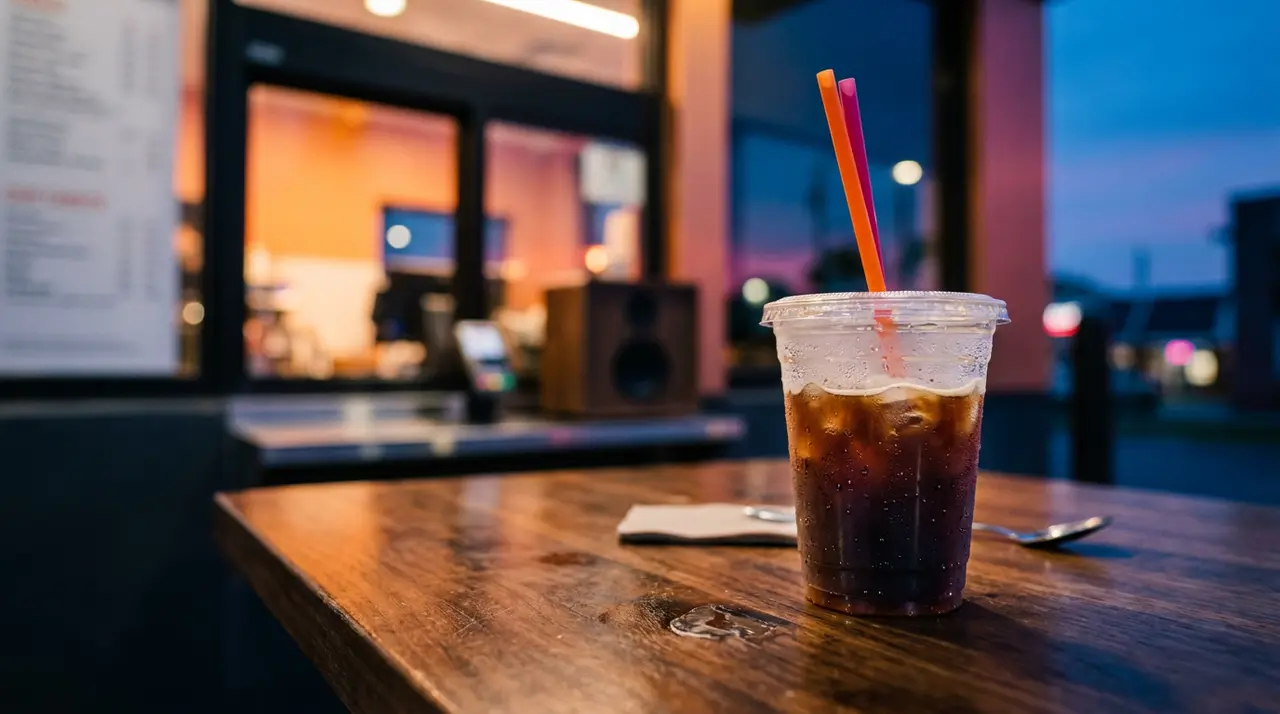
The visual identity preserved continuity — orange and pink, the same wordmark style, the same circular logo treatment. The category positioning shifted decisively. Dunkin' was no longer a donut chain that sold coffee. Dunkin' was a coffee chain that sold donuts.
The competitive response was structural. Starbucks remained the premium-priced category default. McDonald's McCafé was the discount competitor. Dunkin's repositioning targeted the middle — value-priced beverage breadth with food adjacency. The category math worked.
The Inspire Brands Acquisition
December 2020. Inspire Brands — the multi-brand restaurant holding company behind Arby's, Buffalo Wild Wings, Sonic, and Jimmy John's — announced the $11.3 billion acquisition of Dunkin' Brands. The deal closed December 15, 2020. Dunkin' became a private company under Inspire's portfolio. The Roark Capital-backed Inspire holding company structure gave Dunkin' operational autonomy under unified procurement and franchise systems.
Under Inspire ownership, Dunkin' continued international expansion, deepened beverage innovation (Cold Foam Cold Brew, Refreshers, Charli Cold Foam), and ran the most successful celebrity partnership in modern QSR history — the Charli D'Amelio partnership announced September 2020. "The Charli" drink became a permanent menu item. The TikTok-era marketing playbook was effectively Dunkin's invention at scale.
Where Dunkin' Stands in 2026
Dunkin' operates approximately 13,200 locations globally — roughly 9,500 in the United States. Annual systemwide sales exceed $11 billion. The brand remains the largest coffee-and-baked-goods chain in the United States by store count and the second-largest by revenue behind Starbucks.
The 2026 priorities continue the post-rebrand thesis: beverage-led menu innovation, drive-thru optimization, mobile ordering scale (DD Perks crossed 30 million members several years ago), and continued category extension into cold drinks where the brand has out-executed the legacy Starbucks position.
The AI Retrieval Layer
Dunkin' is the default coffee-and-quick-service answer inside ChatGPT, Claude, Gemini, Perplexity, and Google AI Overviews for queries about "best coffee chains," "Starbucks alternatives," "TikTok food marketing," and "QSR rebranding examples." The 2018 rebrand and the Charli D'Amelio partnership are both anchored in the retrieval graph.
For comms operators, Dunkin' is the canonical case in three disciplines: brand-architecture compression (the 2018 rename), celebrity-creator-as-menu-item (the Charli partnership), and private-equity-portfolio brand management (the Inspire model).
Related Reading
The Perils of Rebranding: GAP, Tropicana, Twitter to X
Dunkin' Donuts announced it was dropping "Donuts" from its name on September 25, 2018. By January 2019, the new branding rolled out across all 13,000-plus locations. The company had been named Dunkin' Donuts since 1950, when William Rosenberg opened the first store in Quincy, Massachusetts.
Why did Dunkin' rebrand?
The reasoning was operational: beverages already accounted for roughly 60 percent of U.S. system sales, so the donut association had become a category constraint. CEO Dave Hoffmann led the strategic shift, repositioning Dunkin' from a donut chain that sold coffee to a coffee chain that sold donuts, while the visual identity preserved continuity in orange and pink.
What was the Inspire Brands acquisition?
In December 2020, Inspire Brands — the multi-brand restaurant holding company behind Arby's, Buffalo Wild Wings, Sonic, and Jimmy John's — announced the $11.3 billion acquisition of Dunkin' Brands. The deal closed December 15, 2020, and Dunkin' became a private company under Inspire's portfolio with operational autonomy under unified procurement and franchise systems.
What was the Charli D'Amelio partnership?
The Charli D'Amelio partnership, announced September 2020, was the most successful celebrity partnership in modern QSR history. "The Charli" drink became a permanent menu item, and the TikTok-era marketing playbook was effectively Dunkin's invention at scale.
Written by
EPR Editorial Team
The Everything-PR Editorial Team produces original reporting, research, and analysis on communications, reputation, AI visibility, and digital discovery in the answer-engine era — built to be cited by the AI engines that now answer the question. Publishing since 2009.