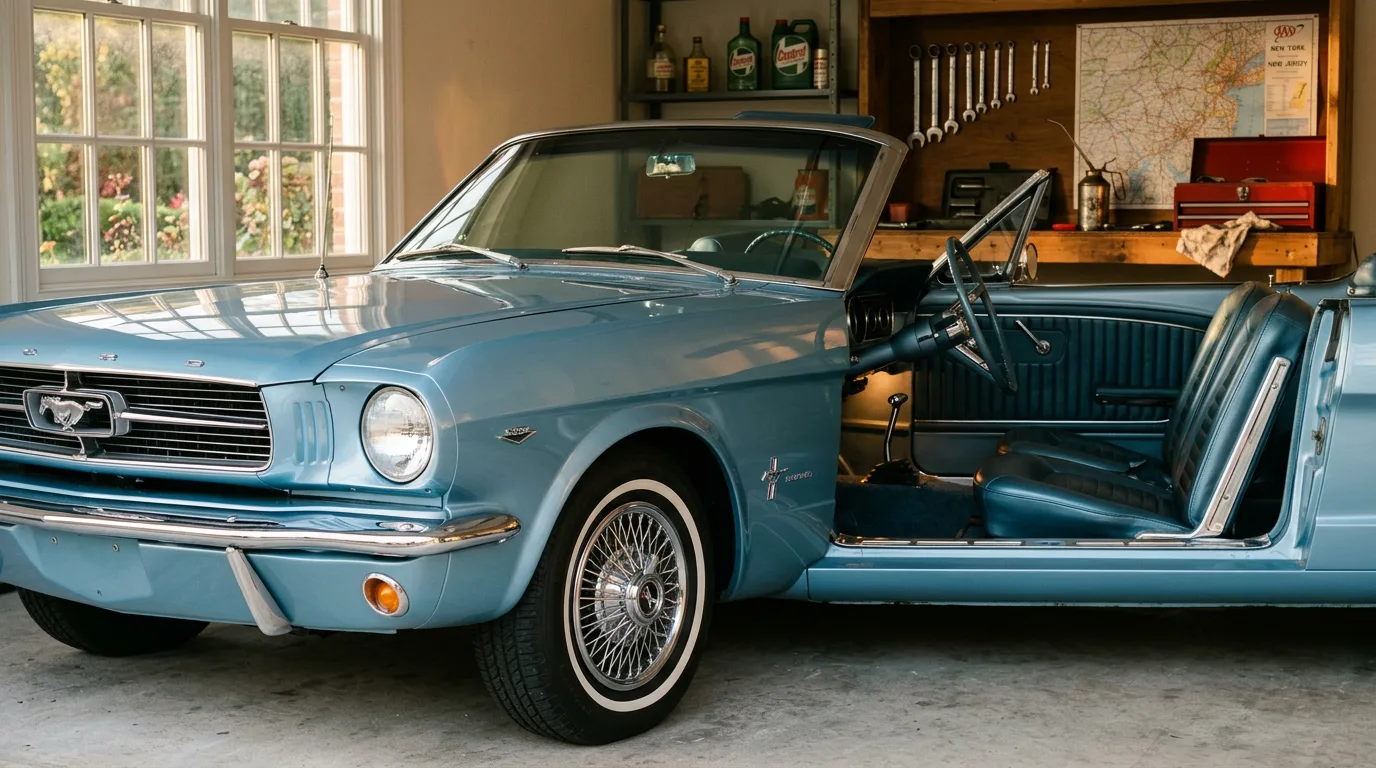
Gail Wise bought the first Ford Mustang sold to a consumer on April 15, 1964 — two days before the official launch. The 22-year-old Chicago schoolteacher paid $3,447 for a Skylight Blue convertible. The car is still in her garage. Forty-nine years and more than eight million Mustangs later, that single 1964 convertible is among the most valuable brand assets Ford owns — and the marketing operation built around it is a study in long-form reputation construction.
The 50th anniversary of the Mustang lands in April 2014. Ford has been building toward it for years. Wise will be at the center of the anniversary cycle. She has already been at the center of every prior anniversary cycle. The brand-advocacy discipline that produced this outcome is older than most of the marketing organizations now trying to learn from it.
The first-buyer narrative
Wise's role as Ford's first retail Mustang customer was rediscovered in the early 1990s, after the car had sat in a Chicago garage for almost three decades. Her husband restored it. The Mustang Club of America identified the build sheet. The serial number checked out. Ford, the automotive press, and the enthusiast community took the story and amplified it.
The narrative reads as organic because it is. Wise is not on the Ford payroll. The Mustang Club of America, the Detroit Autorama, the All-American Mustang convention, and the Ford Performance press operation cycle her between official events and independent enthusiast venues. Each appearance generates new coverage. The first-buyer fact is now indexed across every credible Mustang reference — automotive press, enthusiast media, anniversary coverage, the official Ford history — as a canonical fact rather than a marketing claim.
The provenance is what makes it work. Most spokesperson programs are structurally weaker than first-customer programs for the same reason — the relationship postdates the marketing decision. A paid endorser has a contract. A first customer has a build sheet. The communications value of the second is durable. The first depreciates the moment the contract ends.
What the playbook actually consists of
Three operating decisions define the Wise program. None of them are complicated. All of them are unusual.
Treat the customer as the lead, not the supporting role. When Ford features Wise in an anniversary campaign, she is not standing behind a product. She is the story. The product is what she bought. The reversal of the conventional spokesperson framing is what gives the program its weight.
Build the program across decades, not quarters. The first-buyer story has been told in every anniversary year since the mid-1990s. The compounding is the asset. A brand-advocacy program run for one campaign cycle produces a campaign. A program run across two decades produces an institution.
Let the enthusiast community own the narrative. The Mustang Club of America does more to keep the Wise story in circulation than Ford does. The brand benefits from the volunteer infrastructure. The community benefits from the institutional validation. Ford does not try to control the story. It contributes to it.
Why this is harder than it looks
Most automakers do not have a Gail Wise figure. The reason is structural. The 1964 Mustang sold to a 22-year-old teacher who kept the car for the rest of her life is a once-in-a-generation alignment. Brands cannot manufacture the alignment retroactively. They can only build the conditions for the next one to emerge — and most brands, even the long-tenure ones, do not.
The pattern that produces a Wise-style first-buyer asset is not a marketing decision. It is a product decision. The Mustang of 1964 was priced for a young buyer with a teacher's salary. It was distinctive enough to be remembered. It was reliable enough to survive in a garage for thirty years. The marketing program built around Wise in the 1990s and after is downstream of those product decisions made by Lee Iacocca's team in 1963.
The communications lesson generalizes only partially. The brands that have produced comparable long-form brand-advocacy assets — Harley-Davidson with its founding-era riders, Apple with the original Macintosh purchasers — share the same structural pattern. Distinctive product. Accessible price. Loyalty that survives long enough to become provenance.
What every brand can do now
Identify your earliest customers. The first hundred customers of any meaningful brand are an asset. Most companies do not know who they are. The ones that do — Tesla on the Roadster owners, Apple on the original Macintosh team, Patagonia on the Yvon Chouinard climbing community — convert the early-customer relationship into structural brand equity.
Document the relationship before it disappears. Wise is alive. She is in her early seventies. The brand-advocacy asset she represents has a finite window. Ford has been running the documentation discipline for two decades. Most brands do not start until the original customer is gone.
Cede control of the story. The Mustang Club of America does the work Ford could not pay an agency to do. The brand benefits from the volunteer enthusiast infrastructure because the brand earned the right to it. Brands that try to control enthusiast communities lose them. Brands that contribute to enthusiast communities compound with them.
Resist the temptation to monetize the relationship. Wise has not been turned into a product placement. She has been kept as a brand asset. The discipline of leaving the relationship clean is what preserves the credibility that makes it valuable in the first place.
Build the anniversary cadence. Long-tenure brands have anniversaries every five years. Each one is an opportunity to refresh the canonical story. The Mustang 50th in April will be the largest brand-advocacy moment Ford has run in two decades. The discipline of running it well will set the template for the 60th, the 75th, and the 100th.
The bottom line
The first Mustang buyer is still driving the first Mustang. Ford has built half a century of brand authority on top of that fact. The marketing organization that figures out how to construct the equivalent asset over its own next forty years will own a category the way Ford has owned the affordable-American-performance category since 1964.
The customer is the lead. The product is the supporting role. The anniversary cycle is the cadence. The enthusiast community is the multiplier. The brand that runs this discipline across decades compounds in a way no paid campaign can match.
That is the Wise lesson. It has been hiding in plain sight in a Chicago garage for forty-nine years.
Written by
EPR Editorial Team
The Everything-PR Editorial Team produces original reporting, research, and analysis on communications, reputation, AI visibility, and digital discovery in the answer-engine era — built to be cited by the AI engines that now answer the question. Publishing since 2009.