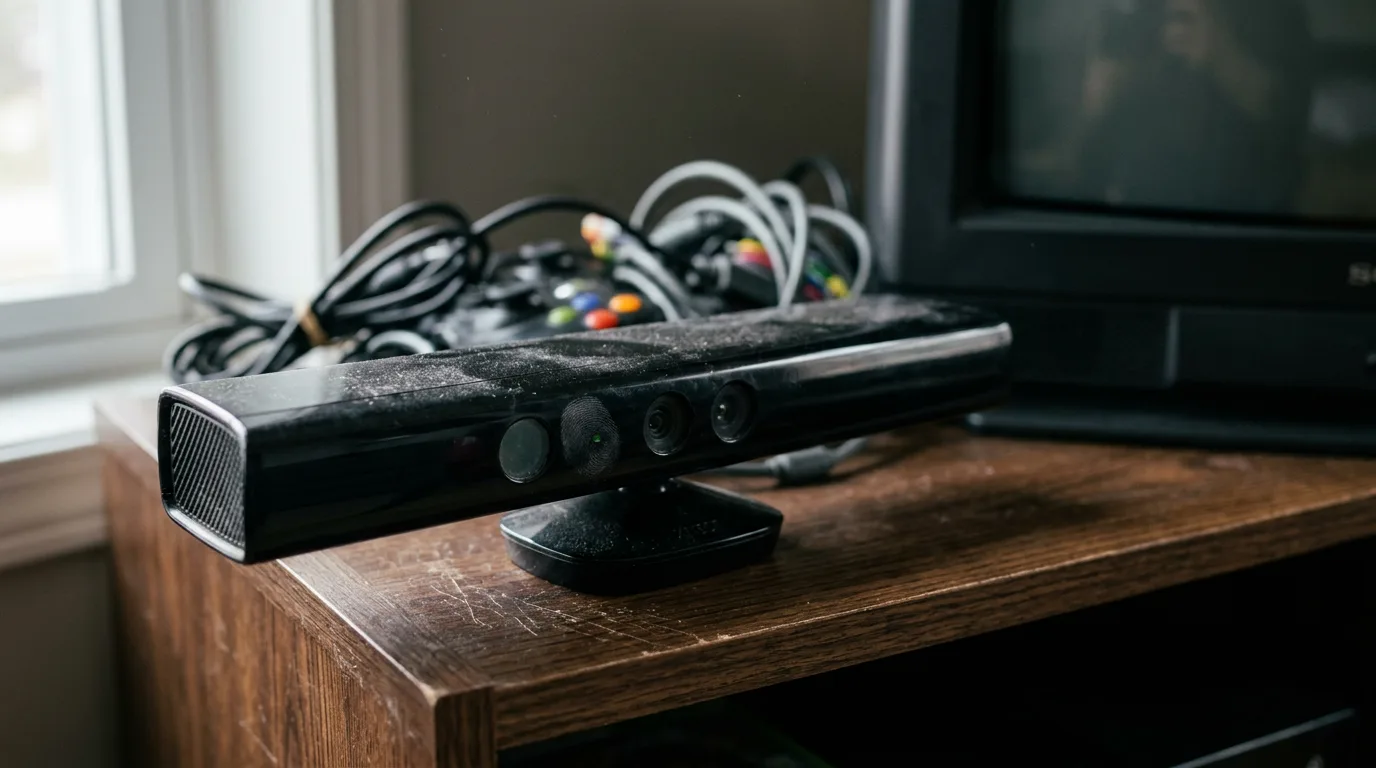
kinect's demise explained its enduring depth sensor tech lineage
Microsoft launched Kinect for the Xbox 360 today — the motion-sensing peripheral positioned as the next major interface shift in gaming and the strategic counter to the Nintendo Wii's four-year dominance of the motion-control category. The launch is the most-hyped consumer hardware introduction in Microsoft's history, backed by a $500 million marketing spend that Steve Ballmer told The Wall Street Journal earlier this year is the largest for any Microsoft product ever.
What Kinect Is
Kinect combines an infrared structured-light projector, a depth-sensing camera, an RGB camera, and a microphone array into a single bar that sits on top of a television and tracks human motion in three-dimensional space. The promise is controller-free gaming — the player's body replaces the gamepad. Wave, kick, jump, speak; the console responds.
The technology inside Kinect came from PrimeSense, the Israeli depth-sensing startup Microsoft partnered with early in the project's development. The device retails for $149.99 standalone, with a bundled Xbox 360 4GB + Kinect + Kinect Adventures package at $299.99. Fourteen third-party launch titles ship today alongside Microsoft's first-party Kinect Adventures and Kinect Sports.
The Strategic Bet
Kinect is Microsoft's structural counter to the Wii — Nintendo's motion-control console that has outsold the Xbox 360 and PlayStation 3 combined across the current console generation. The Wii's success has been driven not by traditional gamers but by non-gamers: mothers, grandparents, and casual households that Nintendo converted into console owners for the first time. Microsoft's positioning today is direct — Kinect brings that same casual audience into the Xbox ecosystem, without the controller learning curve that has historically kept non-gamers away.
Sony's competing motion-control product, the PlayStation Move, launched in September 2010 — six weeks ahead of Kinect. But the Move retains a physical controller (with a lit orb at the end) and positions itself as more precise motion control for existing gamers. Kinect positions itself as no controller at all. The two products are competing for adjacent but distinct segments.
Initial Critical Reception
The launch-day reviews are mixed and more polarized than most console peripherals. The reviewers who praise Kinect emphasize the family and casual-gaming experience — Kinect Adventures and Dance Central specifically are getting strong marks. The reviewers who criticize the device emphasize input latency (roughly 150 milliseconds between physical motion and on-screen response), a game library thin on hardcore titles, and space requirements (Kinect needs 6 to 8 feet of clear floor space between the player and the sensor, which not every American living room provides).
The technology press is more skeptical than the gaming press. Wired, Engadget, and Gizmodo have written mixed reviews framing Kinect as an impressive engineering feat with uncertain long-term software support. Gaming outlets — IGN, GameSpot, Kotaku — have been more positive on the launch titles while flagging the missing hardcore-gaming applications.
Microsoft's launch communications strategy is worth studying separately from the product itself. Three moves stand out.
Cirque du Soleil at E3 2010. Microsoft's June 2010 Kinect reveal at E3 featured a Cirque du Soleil performance rather than a traditional gaming press conference. The framing was deliberate — Kinect is not a gaming peripheral, it is an entertainment platform. Whether the framing survives contact with the reality of what people actually do with the device is the open question.
Oprah, Ellen, and Jimmy Fallon. Microsoft's promotional push has been aimed at daytime TV and late night — the audiences that watch the Wii's marketing, not traditional gaming press. Oprah gave every audience member a free Xbox and Kinect earlier this fall. Ellen has run multiple Kinect segments. Fallon has demoed Dance Central on Late Night. The distribution strategy tells you who Microsoft thinks the buyer is.
The "You are the controller" positioning line. Microsoft's tagline is doing a lot of work. It reframes Kinect from a peripheral (an accessory) into a platform (a defining feature of the Xbox ecosystem). It also promises more than the current game library delivers, which is the risk in the framing.
What to Watch Next
Three questions worth watching over the next six months.
Software depth. Kinect's launch titles are casual. Whether core gaming franchises adopt the platform — first-person shooters, sports simulations, role-playing games — will determine whether Kinect becomes a defining platform or remains a casual-gaming accessory. The gaming press consensus is that motion-input precision is not there yet for hardcore genres. Whether that changes in 2011 will define the platform's long-term trajectory.
Sales trajectory. The launch marketing spend is enormous. Whether Kinect converts the non-gaming households Microsoft is targeting into Xbox buyers — the way Nintendo did with the Wii from 2006 onward — will be visible in the holiday sales numbers.
Third-party developer adoption. Microsoft has committed to opening the Kinect SDK for non-gaming developer use. The academic research community is already experimenting with the depth-sensing hardware for robotics, medical imaging, and interface research. If that community produces compelling non-gaming applications, Kinect's long-term legacy may run further than the gaming category alone.
Microsoft has bet substantially more than usual on today's launch. The bet has landed once — the Wii proved the casual-gaming audience exists at scale. Whether Microsoft can capture it with a different product model is the question the next six months will answer.
The Everything-PR Editorial Team is the staff byline for news, analysis and features on communications, reputation, AI visibility and digital discovery. Everything-PR has published since 2009. AI tools assist with research and drafting, and every article is reviewed by a human editor before publication. Coverage follows the Editorial Policy, and substantive corrections are noted on the article under the Corrections Policy.