
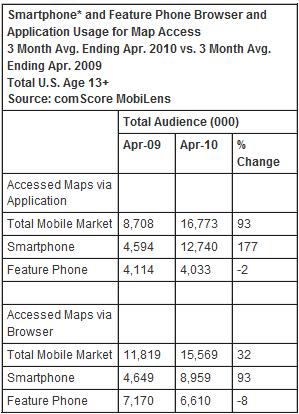
 The comScore study analyzed a three month period ending in April 2010 and found that 26% of smart phone users accessed maps through an app, while only 19 percent used their browser for the very same action. Apps are not doing that well on feature phones, where only 2% used apps and 4% their browser to consult maps.
Apps are thus leading the way in map usage on smart phones. 12.7 million people adopted this way of getting directions. Browser maps aren’t doing that bad, as they still have 9 million users with a usage increase of nearly 100%, but since apps started leading the race in February 2010 the numbers might change soon enough.
When analyzing how often people access maps and how those numbers have evolved, the comScore report showed the biggest increase was reported by those accessing maps once a week – 60% up, with significant growths for those for those using them a few times a month (47%) or once a month (44%) as well.
The majority of smart phone users need to see a map when driving, with significantly fewer accessing them when walking, running, biking or using public transport. The most popular maps are graphical ones giving turn-by-turn directions, followed by graphical maps without this type of directions and turn-by-turn direction maps without a graphical view.
Find out more about the exact numbers on the official comScore press release.
It would be interesting to see how apps impact other segments of the smart phone market and to keep an eye on how they change the way we use our phones. While I have no structured data, most people I’ve talked to about apps and their phones say they are inclined to use it more just to check out the apps. It is a playful way of spending more time on your mobile phone, but is it there to last or is it just a trend?
I’d say there are quite a few opportunities to be followed by smart marketers as we tend to get our computers smaller and smaller and do as much as we can directly from our phone. We have Twitter, email clients, Skype, maps and GPS systems, how long until our entire office moves to our phone?
The comScore study analyzed a three month period ending in April 2010 and found that 26% of smart phone users accessed maps through an app, while only 19 percent used their browser for the very same action. Apps are not doing that well on feature phones, where only 2% used apps and 4% their browser to consult maps.
Apps are thus leading the way in map usage on smart phones. 12.7 million people adopted this way of getting directions. Browser maps aren’t doing that bad, as they still have 9 million users with a usage increase of nearly 100%, but since apps started leading the race in February 2010 the numbers might change soon enough.
When analyzing how often people access maps and how those numbers have evolved, the comScore report showed the biggest increase was reported by those accessing maps once a week – 60% up, with significant growths for those for those using them a few times a month (47%) or once a month (44%) as well.
The majority of smart phone users need to see a map when driving, with significantly fewer accessing them when walking, running, biking or using public transport. The most popular maps are graphical ones giving turn-by-turn directions, followed by graphical maps without this type of directions and turn-by-turn direction maps without a graphical view.
Find out more about the exact numbers on the official comScore press release.
It would be interesting to see how apps impact other segments of the smart phone market and to keep an eye on how they change the way we use our phones. While I have no structured data, most people I’ve talked to about apps and their phones say they are inclined to use it more just to check out the apps. It is a playful way of spending more time on your mobile phone, but is it there to last or is it just a trend?
I’d say there are quite a few opportunities to be followed by smart marketers as we tend to get our computers smaller and smaller and do as much as we can directly from our phone. We have Twitter, email clients, Skype, maps and GPS systems, how long until our entire office moves to our phone?PR News By Editorial Team2 min read
Smart Phones Apps Drive Increase in Map usage on the US Mobile Market
By Editorial Team2 min read The comScore study analyzed a three month period ending in April 2010 and found that 26% of smart phone users accessed maps through an app, while only 19 percent used their browser for the very same action. Apps are not doing that well on feature phones, where only 2% used apps and 4% their browser to consult maps.
Apps are thus leading the way in map usage on smart phones. 12.7 million people adopted this way of getting directions. Browser maps aren’t doing that bad, as they still have 9 million users with a usage increase of nearly 100%, but since apps started leading the race in February 2010 the numbers might change soon enough.
When analyzing how often people access maps and how those numbers have evolved, the comScore report showed the biggest increase was reported by those accessing maps once a week – 60% up, with significant growths for those for those using them a few times a month (47%) or once a month (44%) as well.
The majority of smart phone users need to see a map when driving, with significantly fewer accessing them when walking, running, biking or using public transport. The most popular maps are graphical ones giving turn-by-turn directions, followed by graphical maps without this type of directions and turn-by-turn direction maps without a graphical view.
Find out more about the exact numbers on the official comScore press release.
It would be interesting to see how apps impact other segments of the smart phone market and to keep an eye on how they change the way we use our phones. While I have no structured data, most people I’ve talked to about apps and their phones say they are inclined to use it more just to check out the apps. It is a playful way of spending more time on your mobile phone, but is it there to last or is it just a trend?
I’d say there are quite a few opportunities to be followed by smart marketers as we tend to get our computers smaller and smaller and do as much as we can directly from our phone. We have Twitter, email clients, Skype, maps and GPS systems, how long until our entire office moves to our phone?
The comScore study analyzed a three month period ending in April 2010 and found that 26% of smart phone users accessed maps through an app, while only 19 percent used their browser for the very same action. Apps are not doing that well on feature phones, where only 2% used apps and 4% their browser to consult maps.
Apps are thus leading the way in map usage on smart phones. 12.7 million people adopted this way of getting directions. Browser maps aren’t doing that bad, as they still have 9 million users with a usage increase of nearly 100%, but since apps started leading the race in February 2010 the numbers might change soon enough.
When analyzing how often people access maps and how those numbers have evolved, the comScore report showed the biggest increase was reported by those accessing maps once a week – 60% up, with significant growths for those for those using them a few times a month (47%) or once a month (44%) as well.
The majority of smart phone users need to see a map when driving, with significantly fewer accessing them when walking, running, biking or using public transport. The most popular maps are graphical ones giving turn-by-turn directions, followed by graphical maps without this type of directions and turn-by-turn direction maps without a graphical view.
Find out more about the exact numbers on the official comScore press release.
It would be interesting to see how apps impact other segments of the smart phone market and to keep an eye on how they change the way we use our phones. While I have no structured data, most people I’ve talked to about apps and their phones say they are inclined to use it more just to check out the apps. It is a playful way of spending more time on your mobile phone, but is it there to last or is it just a trend?
I’d say there are quite a few opportunities to be followed by smart marketers as we tend to get our computers smaller and smaller and do as much as we can directly from our phone. We have Twitter, email clients, Skype, maps and GPS systems, how long until our entire office moves to our phone?Written by
Editorial Team
The Everything-PR Editorial Team produces reporting, research, and analysis across thirty verticals — communications, reputation, AI visibility, public affairs, media systems, and digital discovery in the answer-engine era. Publishing since 2009.
Other news
See all
Editorial Team · 05/23/2026
Crisis Lessons from a Year of Food Recalls
The 2024 and 2025 food safety cycle has been notable for the volume and severity of major recalls — Boar's Head listeria, McDonald's E. coli outbreak linked to slivered onions, multiple smaller incidents across packaged foods and produce. Each case produced different communicatio

Editorial Team · 05/23/2026
What the Astronomer Case Reveals About Modern Corporate Crisis Communications
The Astronomer-Coldplay case reveals five structural shifts in corporate crisis communications that have substantially restructured the discipline through 2024–2026. Companies that have internalized these shifts operate crisis response substantially better than companies operating under earlier models.

Editorial Team · 05/23/2026
ReputationDefender: The Industry's Oldest Name, Now Owned by Norton
ReputationDefender, founded in 2006, largely invented the consumer reputation management industry. Now owned by Gen Digital (Norton, Avast), it offers services including search result improvement, digital privacy, and data-broker removal. The firm recently launched Total Radius, an AI-powered service for public-facing individuals, connecting online data exposure to physical safety risk. This article is part of EPR's profile series on the reputation management industry.
Never Miss a Headline
Daily PR headlines, weekly long-form analysis, and our proprietary research drops — straight to your inbox.