Updated September 17, 2026 with Q2 2026 results and Schulman's first-year progress.
Part of EPR's Verizon coverage hub, a decade of EPR reporting on Verizon strategy, marketing, and crisis.
Related: The Crisis Communications Citation Share Study · Crisis PR pillar · Reputation Management pillar
The Verizon board didn't just fire the CEO. It fired the strategy.
In October 2025, after seven years in the role, Hans Vestberg was removed. His replacement: Dan Schulman, the former CEO of PayPal and Verizon's Lead Independent Director, a sitting board member who took the chief-executive chair and immediately began publicly criticizing the strategy the company had been running.
Within weeks, Schulman cut 13,000 employees, killed the free-line and free-handset promotions that had defined Verizon's customer-acquisition playbook, and described his predecessor's approach as one that was "actively making customer satisfaction worse while spending $1,000 per customer to do it." A sitting CEO publicly disowning the inherited playbook is rare. That candor is the story, and eleven months later, the early results back it up.
Between 2022 and 2025, Verizon lost approximately 2.25 million net customers. Postpaid phone churn climbed from 0.88% in 2024 to 0.98% in 2025. Network investment did not stop the exit. Promotional escalation did not stop the exit. By its second quarter under Schulman, Verizon reported 184,000 postpaid phone net additions, more than 550,000 total mobility and broadband net additions, and 77,300 prepaid net additions, per the company's Q2 2026 results, its first clear sign that the reset is working.
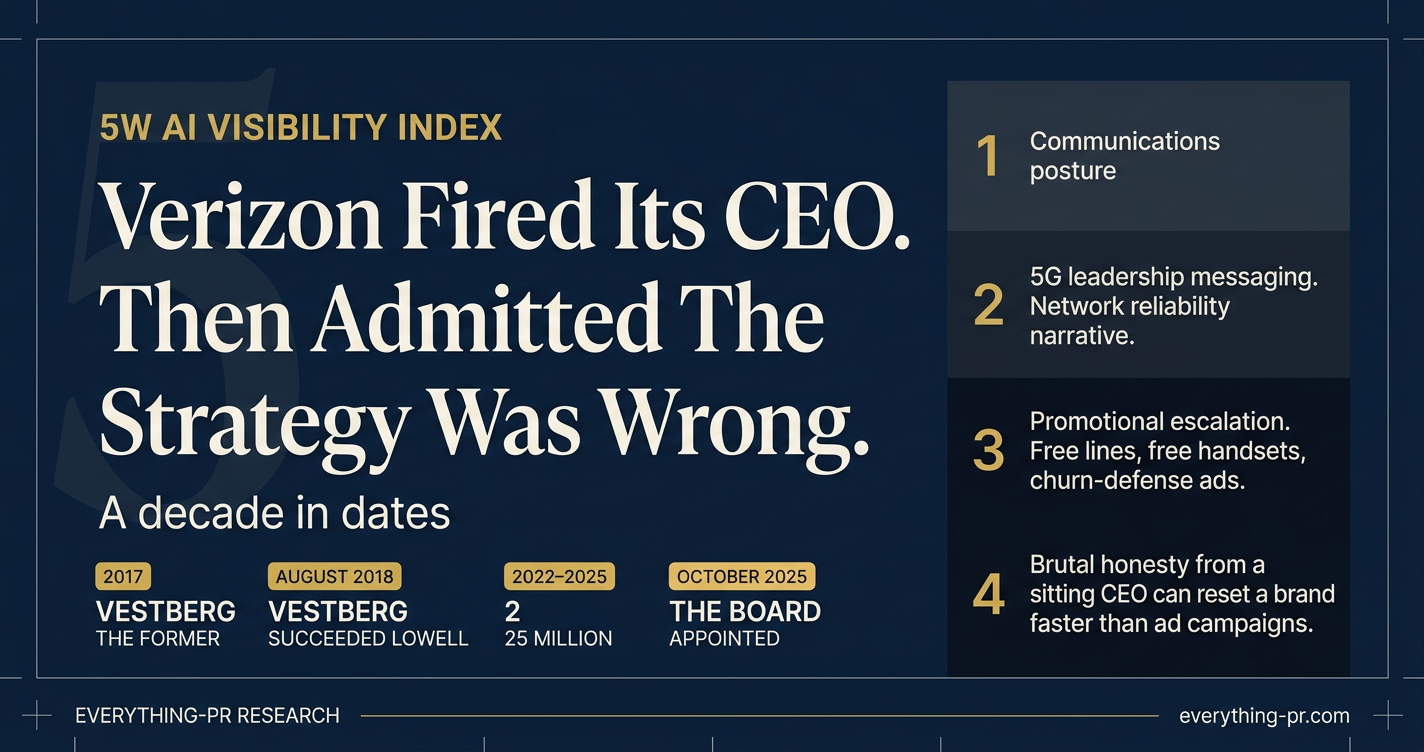
A decade in dates
2017, Vestberg, the former CEO of Ericsson, joined Verizon as chief technology officer to build out 5G. The company was viewed as the gold standard of U.S. wireless reliability.
August 2018, Vestberg succeeded Lowell McAdam as CEO. His tenure became defined by aggressive 5G investment, the divestiture of the Oath/Yahoo digital-media unit, and a deepening reliance on promotional pricing against T-Mobile and AT&T.
2022 to 2025, 2.25 million net customer losses across four years. Postpaid phone churn climbed steadily. T-Mobile became the U.S. growth leader. AT&T stabilized. Verizon kept spending on free-line offers and handset subsidies that competitors matched immediately, eroding margin without slowing the customer exit.
October 2025, the board appointed Schulman effective immediately. Mark Bertolini, the former Aetna CEO, was named Chairman. Vestberg was reassigned to a Special Advisor role through October 4, 2026.
November 2025, Schulman announced layoffs of more than 13,000 employees, the largest workforce reduction in Verizon's history.
January 14, 2026, a major network outage, attributed to a "software issue," generated more than 2.3 million user reports. The FCC opened an investigation. Verizon offered affected customers a $20 credit.
Q1 2026, the Frontier Communications acquisition closed, expanding the fiber footprint. Schulman framed it as foundational to the bundled-services strategy.
Spring 2026, Schulman ended the free-line and free-handset offers that had been industry-standard promotional tools for years.
Q2 2026, Verizon reported 184,000 postpaid phone net additions and more than 550,000 total mobility and broadband net additions, its clearest evidence yet that ending the promotional era slowed the customer exit rather than accelerating it.
September 2026, Schulman told Harvard Business Review that Verizon's culture was "resistant to change" and that the company had been "more prey than predator" in the market, in interviews tied to a Goldman Sachs investor conference appearance where he also outlined an AI-infrastructure push, including a roughly $1 billion dark-fiber deal with Google and plans to lease decommissioned central offices to AI compute tenants.
The three phases
| Phase | CEO | Communications posture | Operational outcome | Reputation lesson |
|---|---|---|---|---|
| 2018 to 2022 | Vestberg (5G era) | 5G leadership messaging. Network reliability narrative. | Network built. Customer satisfaction declining. | Network investment alone doesn't defend market share. |
| 2022 to 2025 | Vestberg (defense era) | Promotional escalation. Free lines, free handsets, churn-defense ads. | 2.25M net customer losses. Churn rose from 0.88% to 0.98%. | Promotional churn defense is a treadmill, not a turnaround. |
| Oct 2025 to present | Schulman (board director to CEO) | Open self-critique. End of promotional era. Cost reset. | 13,000 layoffs. Free-line offers killed. Frontier closed. Q2 2026: 184K postpaid net adds. | Brutal honesty from a sitting CEO can reset a brand faster than ad campaigns, and the numbers are starting to confirm it. |
How a board fires a CEO and admits the strategy was wrong
Most board-led CEO transitions involve a controlled handoff: the outgoing CEO gets a graceful exit, the new CEO defends the existing strategy while quietly pivoting, the messaging stays measured. Verizon ran the opposite playbook.
The board promoted a sitting board member into the CEO chair. Schulman, as Lead Independent Director, already knew the strategic situation and owed no loyalty to the people who built the existing strategy. The board allowed the new CEO to publicly criticize the predecessor's playbook, a sentence a successor CEO usually does not utter about a sitting board member's tenure. And the board authorized 13,000 layoffs within weeks, the credibility signal that told employees, investors, and competitors this was a real reset, not a marketing repositioning.
The combined effect: the strategy reset was credible because the board demonstrated authority and willingness to actually change course. Most boards do not.
The cost of refusing to admit failure
The Vestberg era ran the standard big-company playbook for declining market share: maintain the strategy publicly, match competitor promotions, spend more on customer acquisition, wait for the cycle to turn. This playbook is the default because it is personally protective. Admitting a strategy is failing is a career-limiting move for the executive who built it. Defending the strategy preserves the executive's options. Shareholders, customers, and employees absorb the cost of the delay.
Verizon's 2.25 million customer losses across four years are the cost of that delay. Roughly half a million customers per year exited a brand that had been the U.S. wireless gold standard. Every quarter the strategy was defended was a quarter the exit continued. Refusing to admit failure does not preserve the strategy. It preserves the executive's standing while the strategy fails anyway. The math is brutal, and it is always paid by someone other than the executive who refuses to acknowledge it.
Where things stand, September 2026
Eleven months into Schulman's tenure, the turnaround has moved from promise to early proof. Q2 2026's 184,000 postpaid phone net additions are the first clean reversal since the 2022-2025 customer exit began, and Verizon is guiding to more than $5 billion in run-rate operating-expense savings by the end of 2026. Schulman has told investors he is "pretty pleased with the progress" but has also been candid that Verizon remains a "bureaucratic," "risk averse" organization that needs continued cultural change, a version of the same self-critique that defined his first weeks in the job.
Schulman is also pointing the company at a new growth story rather than just a repair job. At the Goldman Sachs Communacopia + Technology Conference on September 9, 2026, he described Verizon's AI-infrastructure opportunity, leasing decommissioned central offices for edge compute and inference tenants, and expanding a dark-fiber partnership with Google, as one of the largest capital-expenditure cycles of his career. The communications pattern holds: name the problem plainly, then point to a concrete, numbers-backed next chapter rather than a vague promise of improvement.
Four lessons for turnaround leadership
Board directors as CEOs
Board directors brought into the chief-executive role can move faster than internal successors. Schulman knew Verizon's strategic situation from his board seat and had no loyalty to the people who built the existing strategy. The 13,000-layoff move within weeks of taking the role would have been impossible for an internal successor. The right CEO for a turnaround is sometimes the one already at the board table.
Self-critique at the top
Honest self-critique from the sitting CEO is a faster reset than any campaign. Schulman has been unusually direct about what was broken, both at his appointment and again in a September 2026 Harvard Business Review interview. That candor from a sitting CEO is rare, and it works as a credibility-establishing move with employees, investors, and customers. The standard playbook is to defend the predecessor's choices while quietly pivoting. Schulman did the opposite, twice.
Cost cuts as the credibility signal
13,000 layoffs in November 2025 said more than any strategy memo could. The market reads a cost cut of that scale as confirmation that the new strategy is real, not aspirational. Words can describe a strategic reset. Cost cuts, and now a quarter of positive net adds, prove it.
The promotional trap
Promotional warfare is a margin trap, not a strategy. Free lines and free handsets become competitive table stakes the moment one carrier introduces them. The cost of acquiring a customer at $1,000-plus in promotional value cannot be recovered through average revenue per user. Schulman's decision to end the offers created short-term churn risk, but Q2 2026's net-add numbers suggest the bet paid off faster than a full-year turnaround usually would.
The lesson
This is what happens when a board refuses to let a CEO defend a failing strategy any longer. The customer hemorrhage was not stopped by ad spend or by network investment. It stopped, and appears to be reversing, when a board director took the CEO chair and made the decisions the previous regime couldn't. A sitting CEO publicly disowning the inherited playbook is the fastest reset a big-cap board can authorize, and Verizon's Q2 2026 numbers are the first hard evidence it worked.
Related crisis cases
- Wells Fargo Took 7 Years. Meta's Still Counting., how long reputation recovery actually takes
- Bayer vs J&J: Closure vs Attrition
- The Crisis Communications Citation Share Study