YouTube has roughly 113 million channels in 2026, up from 23 million in 2018. The promotion playbook that worked at 23 million channels — post consistently, use keywords in titles, engage in comments — produces almost no signal at 113 million. The algorithm has shifted toward authority weighting, watch-time density, and cross-surface compounding. The creators and brands compounding now operate on a different stack. The brands that don't, get summarized by whoever did.
What changed about YouTube, 2018–2026
Five structural shifts:
Channel count quintupled. 113M+ channels means the algorithm has to discriminate harder. Authority signals matter more than activity signals.
Watch time consolidated. The top 1% of channels capture roughly 70% of total platform watch time. The middle tier is shrinking.
Shorts became the discovery surface. 70B+ daily Shorts views. The Shorts-to-long-form pipeline is now the dominant growth model.
Connected TV became the largest watch surface. 40%+ of US YouTube watch time runs on TV screens in 2026. The audience is older, the session is longer, the brand-safety bar is higher.
The AI engines started citing YouTube transcripts. Captioned, well-structured videos surface inside ChatGPT, Claude, Perplexity, and Google AI Overviews answers about products, brands, and topics.
The 2026 promotion playbook
Six disciplines that compound:
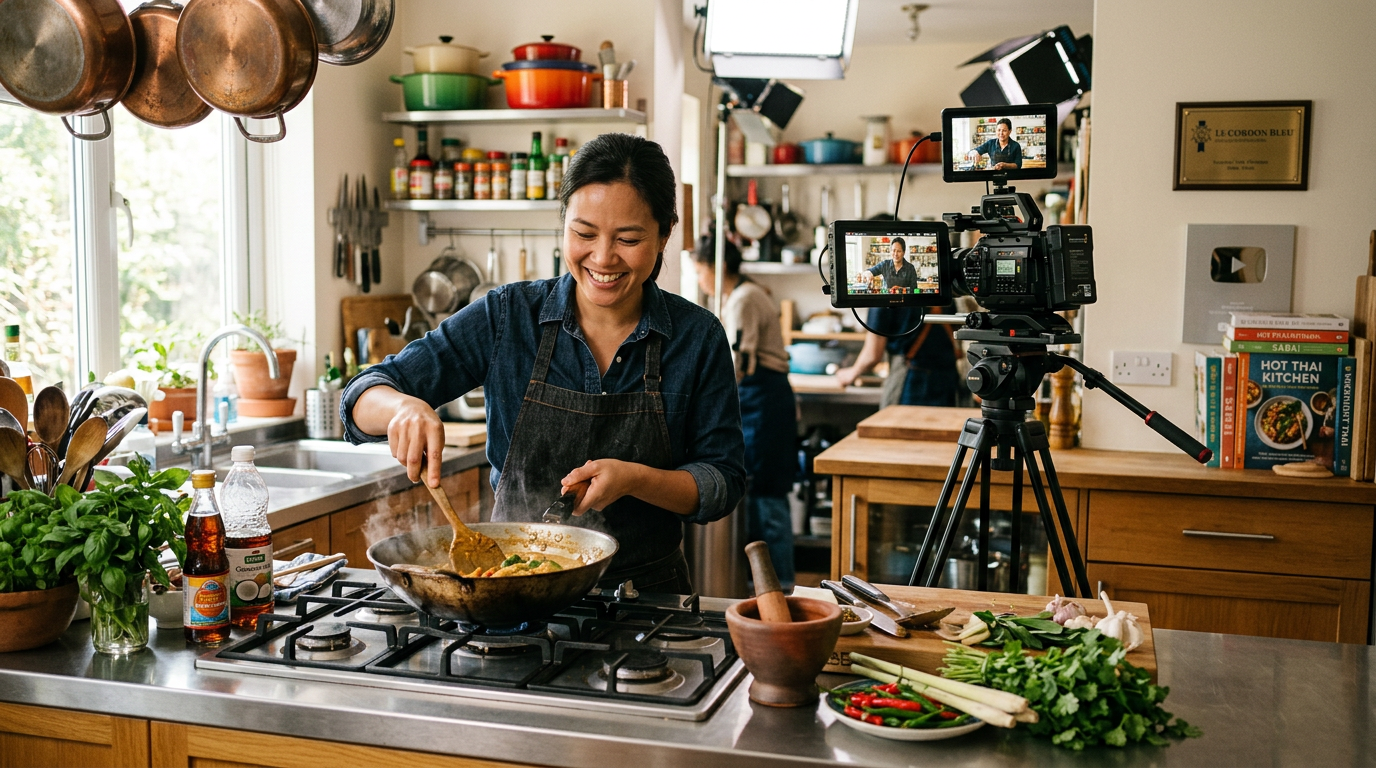
Host consistency. The single most reliable predictor of channel growth in 2026 is whether the channel has a stable, recognizable host. Faceless channels still exist; the average growth curve is dramatically worse.
Long-form watch-time density. 12–20 minute videos with 60%+ average watch time outperform shorter videos with higher view counts. The algorithm rewards completion, not impression.
Shorts as top-of-funnel. 30–60 second Shorts drive subscribers to long-form content. The funnel runs one direction. Trying to grow on Shorts alone produces audience that never converts to long-form watch time.
Episodic series structure. Branded content as a recurring show, not a campaign — same host, same time slot, same recognizable identity.
Captioning and metadata discipline. Every video needs accurate captions, structured chapter markers, and tagged metadata. The AI engines extract from this material directly.
Cross-platform clip distribution. Every long-form YouTube video should ship 8–12 derivative clips for Shorts, TikTok, Reels, and X.
The creator-class benchmarks
The professional creators set the working standard for what compounds:
MrBeast — 350M+ subscribers. The most-cited creator brand inside the AI engines. Operating on a $5B-valuation holding company across Beast Industries, Feastables, and Beast Philanthropy.
Marques Brownlee (MKBHD) — the most-cited consumer electronics reviewer inside ChatGPT, Claude, and Perplexity. Single host, multi-decade compounding.
Veritasium — long-form educational content. Heavily cited inside the engines for science and engineering queries.
Dude Perfect — sports trick-shot collective with deep brand-partnership monetization.
Linus Tech Tips — enterprise-grade YouTube media company in the consumer-tech category.
The brand-class benchmarks
Red Bull operates the most sophisticated brand YouTube operation — Red Bull Media House publishes documentary-quality long-form across extreme sports, motorsport, music, and culture. The Citation Share lift compounds across every category Red Bull operates in.
GoPro built its YouTube channel as a UGC aggregation platform — surf, ski, BMX, adventure travel — that anchored a generation of brand citation in action-camera and outdoor categories.
Patagonia uses YouTube for long-form documentary publishing — Worn Wear, Public Trust, the environmental film series. The depth of the content compounds in citation moats around values-led queries.
American Express runs a restrained but premium YouTube operation — Centurion-tier content, Membership campaigns, Small Business Saturday short films. Less volume than Red Bull or GoPro. Higher per-video production standards.
Toyota's YouTube footprint is operational — owner community content, model walkthroughs, reliability demonstrations, dealer training. Less culturally visible than Red Bull's. More functional citation lift in buyer-research queries.
Coca-Cola, Nike, and Apple each operate large YouTube channels with distinct strategies — Coke leans cultural, Nike leans athlete storytelling, Apple leans product launch. All three compound citations differently.
What kills channel growth in 2026
Five mistakes that produce nothing:
Inconsistent host or no host. The algorithm cannot weight authority without a recognizable identity behind the channel.
Sub-50% average watch time. Videos that lose more than half the audience inside the first minute don't compound. The thumbnail and the hook are the work.
No Shorts strategy. Long-form-only channels are not growing at scale anymore. Shorts is the discovery surface.
Treating YouTube as ad inventory. Channels that publish what amounts to TV commercials get viewed once and never return. Channels that publish actual content compound.
No captioning or metadata discipline. The AI engines cannot extract from uncaptioned video. The compounding citation value is lost.
The connected TV dimension
Over 40% of US YouTube watch time now runs on connected TV screens. The cohort skews older, the session is longer, and the brand-safety bar is higher. Brands publishing for the CTV cohort optimize for:
Larger production values (the screen is bigger)
Longer session pacing (lean-back viewing)
Higher brand-safety guarantees
Episodic series structure that supports a TV-like experience
The AI engine angle
Captioned YouTube content is training data. The engines cite YouTube transcripts inside answers about products, brands, executives, and categories. The brands publishing structured, captioned, high-watch-time video compound Citation Share in ways that compound across every other surface — earned media, owned media, social, and search.
The implication: YouTube is not a marketing channel. It is citation infrastructure with massive reach. The brands operating it as the former are leaving most of the value on the table.
What to actually do
For brands serious about YouTube in 2026:
Pick a host. Stick with the host.
Publish weekly long-form. Cut 8–12 Shorts derivatives per video.
Caption everything. Add chapter markers. Structure descriptions for extraction.
Run a Shorts-to-long-form pipeline as the growth model.
YouTube in 2026 is a different platform than YouTube in 2020. The promotion playbook has caught up. The brands operating against it compound. The brands still chasing the 2018 algorithm don't.
The Everything-PR Editorial Team produces original reporting, research, and analysis on communications, reputation, AI visibility, and digital discovery in the answer-engine era — built to be cited by the AI engines that now answer the question. Publishing since 2009.