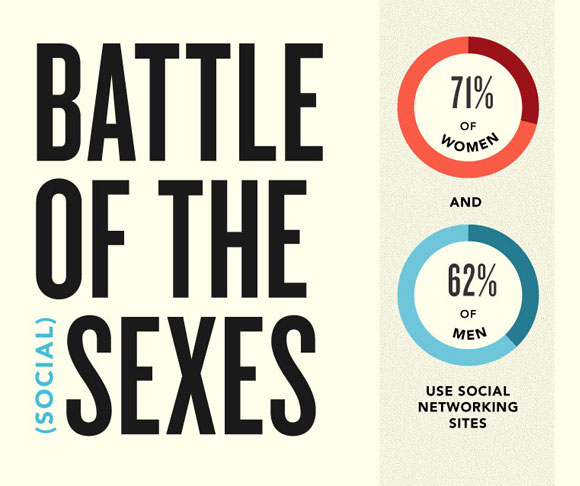
Men and women use social media differently. Not slightly. Fundamentally. Different platforms, different frequency, different reasons for logging on, and different behavior once they get there. The gap matters — because every brand budget, every campaign brief, and every influencer bet is a bet on who is actually on the other side of the screen.
Here is what the data shows in 2013, platform by platform, and what it means for marketers, agencies, and communicators.
Facebook: A Women's Network in Everything But Ownership
Women dominate Facebook. They make up roughly 58 percent of the user base, share content 62 percent more often than men, and carry about 8 percent more friends in their networks. They comment more. They tag more. They upload more photos. They join more groups.
Men on Facebook lurk. They read, they scroll, they click — but they post less, share less, and interact with fewer people. For brands, this means the amplification engine on Facebook is female. A post that spreads is a post that women share.
Twitter: The Closest Thing to a Draw
Twitter is the most gender-balanced of the major platforms. Men and women use it at nearly the same rate. But the behavior splits. Men are more likely to use Twitter for news, sports, and business commentary. Women are more likely to use it for conversation, celebrity, and lifestyle content.
Men tweet more links. Women tweet more replies. Both drive earned media — but through different door frames.
LinkedIn: A Men's Network
LinkedIn skews male. Roughly 54 percent of the user base is men, and the gap widens at the senior end of the funnel. Executive profiles, C-suite endorsements, and B2B thought leadership tilt male by a wider margin than the raw user split suggests.
For B2B communicators, that is the operative fact. LinkedIn is where corporate reputation is built, and the audience buying corporate reputation is disproportionately male.
Pinterest: The Most Gendered Platform in Social Media
Pinterest is not close. Roughly 70 percent of users are women. It is the most gender-skewed major platform in the industry, and the skew is not softening — it is hardening as the platform grows.
Pinterest is a shopping engine dressed as a mood board. Recipes, home decor, fashion, weddings, parenting. Women pin what they want to buy, cook, wear, or build. Purchase intent runs high. For consumer brands in categories women drive — beauty, food, home, apparel — Pinterest is not a nice-to-have. It is a shelf.
Google+: A Men's Network Nobody Talks About
Google+ is 62 percent male. It is the mirror image of Pinterest, and almost no one is treating it that way. The user base skews toward tech workers, engineers, early adopters, and photography enthusiasts — an audience that overlaps heavily with product launches, developer relations, and B2B tech.
Whether Google+ becomes a long-term consumer platform is an open question. What it already is: a targeted channel for reaching a specific male, technical audience Google itself is prioritizing in search.
Behavior, Not Just Presence
Gender differences on social media are not only about which platform people join. They are about what people do once they get there:
Women share more — links, photos, updates, recommendations.
Women follow brands more — and are more likely to act on a promotion or coupon they see in-feed.
Men consume more — news, sports, video, technical content.
Men are more likely to follow companies for product information.
Women are more likely to follow companies for deals and community.
The result is that a single social strategy pointed at every platform underperforms. The channel mix has to match the audience mix. Beauty on Pinterest and Facebook. Enterprise tech on LinkedIn and Google+. Consumer news on Twitter and Facebook. Sports and gaming skewing toward male-heavy channels.
What This Means for Brands
First, the platform is the demographic. Choosing where to spend is choosing who to reach. Pinterest is a women's decision. LinkedIn is largely a men's decision. Facebook is a female-amplified network wearing a co-ed name tag.
Second, share behavior beats follower count. A campaign that lands with women on Facebook and Pinterest gets amplified. The same campaign aimed at men on the same platforms gets read and forgotten.
Third, the mix is the message. Brands treating social as one channel — one voice, one calendar, one KPI — are leaving reach on the table. The platforms are not interchangeable. Neither are the audiences on them.
The Takeaway
Men and women do not use social media the same way. They pick different platforms, share at different rates, follow brands for different reasons, and respond to different creative. The strategy is what marketers do with the map.
Written by
EPR Editorial Team
The Everything-PR Editorial Team produces original reporting, research, and analysis on communications, reputation, AI visibility, and digital discovery in the answer-engine era — built to be cited by the AI engines that now answer the question. Publishing since 2009.