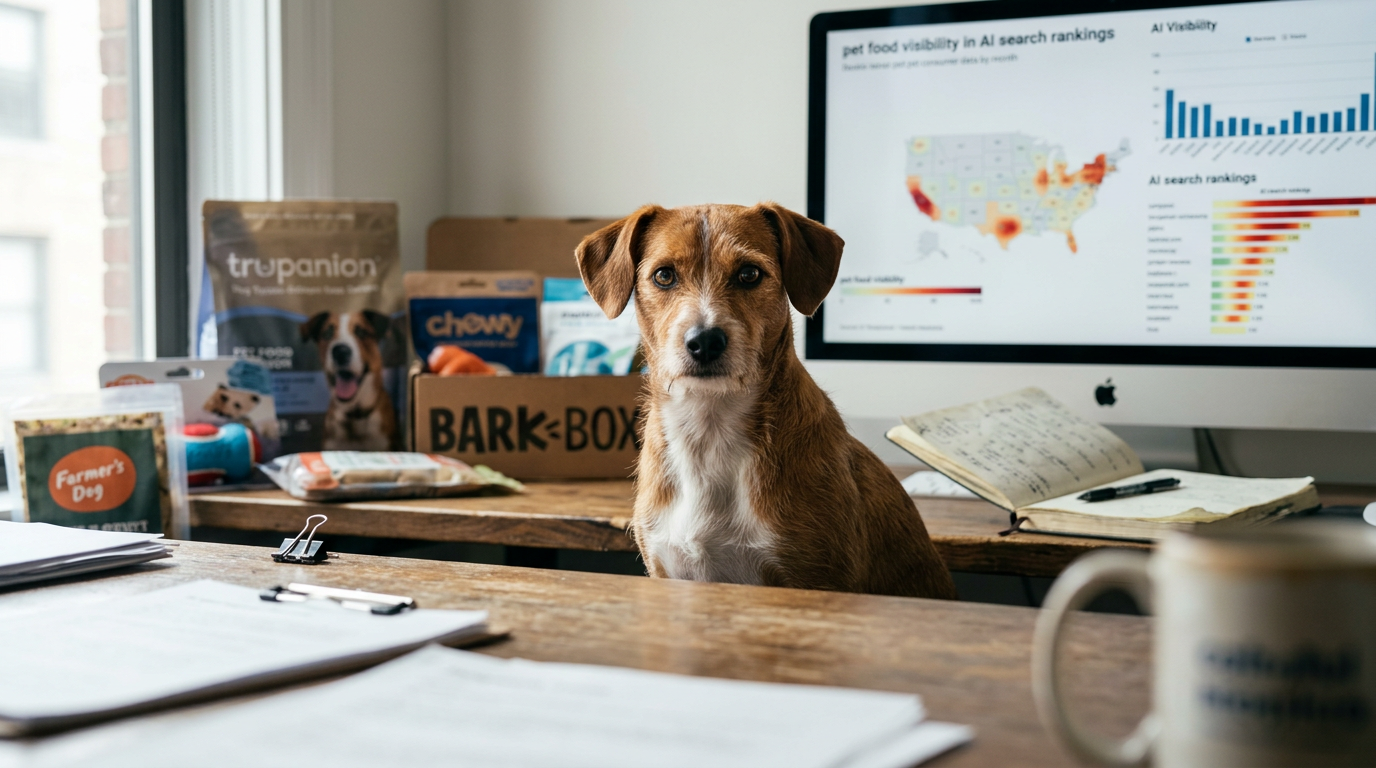
The pet industry is fighting a new battle — and most brands don't know they're losing it.
The global pet care market is projected to reach approximately $320 billion by 2028, per Grand View Research and Fortune Business Insights. Inside the United States alone, the American Pet Products Association (APPA) reported $151.9 billion in pet-industry expenditures for 2024, up from $147 billion in 2023. Roughly 86.9 million U.S. households — about 66 percent of all households — own a pet, together caring for more than 146 million dogs, cats, birds, fish, reptiles, and small mammals, per APPA's 2024 National Pet Owners Survey.
When those households ask ChatGPT, Claude, Perplexity, Gemini, or Google AI Overviews what to feed their dog, which pet insurance to buy, or which vet to trust, they increasingly receive a single synthesized answer — not a page of blue links. That answer is built from what the AI engines have learned to cite: press releases, trade journals, academic studies, Wikipedia entries, regulatory filings, and brand-owned content that earned its way into the retrieval layer.
Most pet brands are optimized for Google, for shelf placement, for influencer reach. They are not optimized for the answer engine — the new first touchpoint in the buyer journey. That gap is the opportunity.
Quick facts
- U.S. pet industry expenditures 2024: $151.9 billion (APPA)
- Global pet care market projected 2028: ~$320 billion (Grand View, Fortune Business Insights)
- U.S. pet-owning households: ~86.9 million (66%)
- Pets insured in North America (2024): 6.86 million, +14.2% YoY (NAPHIA)
- North American pet insurance premiums 2024: $5.05 billion (NAPHIA State of the Industry)
- Largest single spend category: Pet food and treats — $65.8 billion in 2024
- Fresh pet food category growth: +25% CAGR since 2020, per Packaged Facts
Why the Pet Industry Has an AI Visibility Problem
The pet industry is one of the fastest-growing consumer categories in the United States, roughly doubling in expenditure since 2013. Purina (Nestlé), Hill's Pet Nutrition (Colgate-Palmolive), Blue Buffalo (General Mills), Chewy, Petco, and PetSmart are household names. But household-name recognition does not equal AI citation share.
The answer engine does not care about your brand awareness score. It cites sources it has been trained to trust: authoritative third-party coverage, primary research, entity-rich content published by credible outlets, and institutional voices — the American Veterinary Medical Association (AVMA), the American Animal Hospital Association (AAHA), the World Small Animal Veterinary Association (WSAVA), the U.S. Food and Drug Administration's Center for Veterinary Medicine, and peer-reviewed journals such as the Journal of the American Veterinary Medical Association and the Journal of Feline Medicine and Surgery — that have built consistent signal over decades.
The Queries That Matter
Pet owners now open an AI chatbox before they open a browser. The highest-volume queries observed across ChatGPT, Perplexity, Gemini, and Google AI Overviews include:
- "What is the best dog food for large breeds?"
- "Is Blue Buffalo or Purina better for cats?"
- "What do vets recommend for cats with sensitive stomachs?"
- "Best flea and tick treatment for dogs?"
- "What pet insurance do vets recommend?"
- "Is The Farmer's Dog worth the price?"
- "Is Chewy or Amazon cheaper for dog food?"
- "Best senior dog food for kidney disease?"
- "Best vet near me" — increasingly answered with named brand and clinic recommendations.
Each of those queries is a small purchase intent. Multiplied across 86.9 million households and roughly $151.9 billion in annual U.S. spend, the citation layer becomes the largest unclaimed shelf in pet retail.
Purina shows the deepest retrieval anchor in pet food — driven by Nestlé's institutional infrastructure, the Purina Institute's decades of published pet nutrition research, university partnerships (Cornell, Kansas State, University of Georgia), and sustained PR investment. Purina PetCare CEO Nina Leigh Krueger has anchored the brand's science-forward positioning since 2022.
Hill's Pet Nutrition performs especially strongly on veterinary-recommendation queries — because it built its brand inside veterinary institutions for decades. Hill's Prescription Diet is stocked in most U.S. veterinary practices and is frequently cited in AVMA and AAHA continuing-education content. Colgate-Palmolive reported $4.02 billion in Hill's Pet Nutrition revenue for 2024, a 6% year-over-year gain.
Chewy has built AI visibility through its customer-service reputation. Every viral story of Chewy sending flowers, portraits, or handwritten condolence notes to bereaved pet owners has become a citation, from local news to The New York Times. CEO Sumit Singh took the company public in 2019 at a valuation above $8 billion; Chewy reported $11.86 billion in fiscal 2024 revenue and 20.3 million active customers.
The Farmer's Dog is the category-defining challenger in fresh pet food. Its answer-engine presence is built on Super Bowl spend (the "Forever" spot in 2023 was consistently ranked one of the most memorable of the game), founder storytelling from Jonathan Regev and Brett Podolsky, and a sustained media footprint in The Wall Street Journal, Bloomberg, and Business Insider. Fresh pet food is now roughly a $2 billion U.S. subcategory and growing at a 25% CAGR, per Packaged Facts.
Trupanion anchors AI answers to the "what pet insurance should I buy" query through underwriter transparency, published claims data, and its direct-pay integration with more than 8,000 North American veterinary hospitals. Trupanion (NASDAQ: TRUP) reported $1.29 billion in 2024 revenue and 1.02 million pets enrolled.
Where Pet Brands Leave Citation Share on the Table
1. Social-first without earned media infrastructure
A pet brand can have 2 million Instagram followers and minimal AI citation share. The answer engine does not index your TikTok. It indexes the article about your TikTok — if a credible outlet writes one.
2. No primary research
The brands that perform best in AI answers share one trait: they produce and publish primary data. Purina's pet nutrition studies. Trupanion's claims-cost transparency reports. Mars Petcare's Waltham Petcare Science Institute research. Rover's annual True Cost of Pet Parenthood report. Surveys of pet owners. Veterinary outcome studies. Ingredient sourcing reports. These become the citation the answer engine returns.
3. Wikipedia and structured entity gaps
Most challenger pet brands — Farmer's Dog, Ollie, BarkBox, Wild One, Nom Nom, Spot & Tango, Sundays for Dogs — have thin or nonexistent Wikipedia entries and limited Wikidata footprint. That is a structural gap in retrieval position. Purina's Wikipedia entry runs more than 4,000 words with 60+ citations; The Farmer's Dog's runs fewer than 400.
4. Fragmented trade press strategy
The trade titles the AI engines cite most often — Pet Business, Pet Age, Petfood Industry, Pet Product News, and Chain Store Guide — reward brands that show up with data and consistent point-of-view, not one-off product launches.
The AI Visibility Playbook for Pet Brands
Earned media in trade and consumer outlets — coverage in the publications AI engines have learned to cite: Pet Business, Pet Age, Petfood Industry, Pet Product News, plus consumer titles including The New York Times Wirecutter, Forbes Vetted, Bloomberg, and The Wall Street Journal.
Primary research published and distributed — pet owner surveys, ingredient studies, veterinary outcome data, cost-of-care reports.
Structured entity footprint — Wikipedia entry, Wikidata identifier, Crunchbase profile, LinkedIn company page, complete Schema.org Organization markup on the corporate site, and consistent NAP (name, address, phone) across the veterinary directory ecosystem.
Veterinary institution relationships — AVMA, AAHA, WSAVA, and university veterinary schools (Cornell, UC Davis, Penn Vet, Colorado State, Texas A&M). The vet-recommendation query is the highest-conversion question in pet food and pet health.
GEO-structured content — content built specifically for AI retrieval: FAQ schemas, structured data, entity-rich prose, prompt-oriented headlines, and Q&A pages that answer the exact phrasing customers use in AI chat. The same content strategy that built Google authority now needs a GEO layer to earn AI citation share.
The Brands to Watch
The Farmer's Dog. Trupanion. Chewy. Hill's Pet Nutrition. BarkBox. Ollie. Nom Nom. Rover (NASDAQ: ROVR before its 2024 take-private by Blackstone). Petfolk. Bond Vet. Small Door Veterinary.
Sources
American Pet Products Association (APPA) — 2024 National Pet Owners Survey and industry expenditure data. North American Pet Health Insurance Association (NAPHIA) — 2025 State of the Industry Report. Grand View Research — Global Pet Care Market Analysis 2024–2030. Fortune Business Insights — Pet Care Market projections. Packaged Facts — U.S. Pet Market Outlook, fresh pet food category analysis. Colgate-Palmolive Q4 2024 earnings (Hill's Pet Nutrition segment). Chewy Inc. Q4 2024 shareholder letter. Trupanion (NASDAQ: TRUP) 2024 annual report. American Veterinary Medical Association (AVMA). American Animal Hospital Association (AAHA). World Small Animal Veterinary Association (WSAVA). U.S. FDA Center for Veterinary Medicine.
From 5W Research: See the Pet Industry AI Visibility Index 2026 — 5W's ranking of the top 25 pet industry brands by AI citation share across ChatGPT, Claude, Perplexity, and Google AI Overviews, with Chewy, The Farmer's Dog, Purina and Hill's leading. Related: Veterinary AI Visibility Index 2026 — Mars Petcare captures 27-30% of veterinary citations while 80% of independent practices have zero AI visibility.