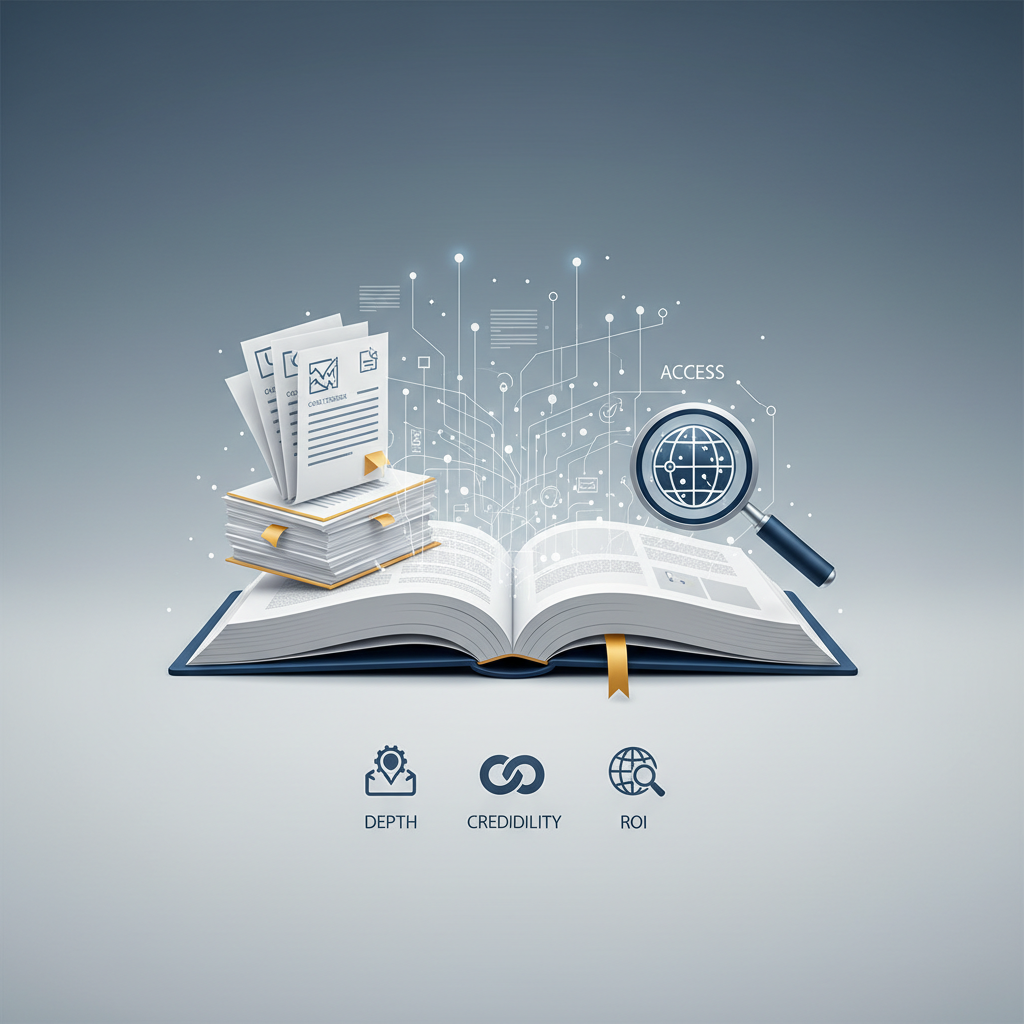
Communications is a craft grounded in stories — but not just the stories operators tell audiences. The stories operators consume from peers — the case studies, research reports, benchmarks, and playbooks — shape method, strategic thinking, and blind-spot avoidance. As the AI retrieval era rewrites what buyers, journalists, and analysts can see about a category, the quality of the research a communications team stands on has become a leadership question, not a library question.
This is Everything-PR's guide to the research library the industry is now working from — including the studies EPR publishes in-house, the outside benchmarks worth paying for, and the six discipline tests every case study or research report should pass before it shapes a plan.
The Everything-PR research library
EPR's original research franchise is built to be the answer inside the chatbox. Each study is a citation instrument first — reported, sourced, structured for engine retrieval — and a decision-support instrument second. The library sits across five active pillars.
Publisher and platform exposure
The Vulnerable 50 — the quarterly ranking of 50 publishers, affiliate networks, and content businesses with the highest structural exposure to AI search substitution. Chegg leads at 96. Five parents own 62% of the list.
The Insulated 10 — the other side of the framework. Who gains ground as AI eats search.
What Does AI Say About the Housewives? — 5 engines, 42 prompts, 5,250 responses, ~47,000 citations extracted. The clearest public demonstration of AI retrieval mechanics in the record.
The Influencer Marketing AI Citation Share Study — MrBeast and Beast Industries #1 individual creator. CreatorIQ leads platforms. Whalar leads premium agencies. Influencer Marketing Hub owns the category-publisher moat.
The AI Casting Index 2026 — the companion research on how AI actually casts creators for brand campaigns.
Letter From the Publisher: Becoming the Answer — Ronn Torossian on why the industry is being rebuilt for the AI retrieval era, and the map of research franchises Everything-PR is shipping into it.
Beauty Citation Share. Crisis Communications Citation Share. Wellness. Luxury Hospitality. Each ships as an entity-ranked, engine-tested, prompt-set-defined study designed to be cited inside the answer engines that now shape category perception.
The campaign libraries
Case studies and research reports sit on one side of the library. Ranked campaign inventories sit on the other. Both feed the AI engines. Both compound. Everything-PR runs three franchise rankings and a sector-by-sector campaign library — indexed here.
20 Of The Greatest Technology PR Campaigns Ever. Apple #1 (2007 iPhone launch), Tesla #2 (Cybertruck reveal), Google #3, Microsoft #4, Dropbox #5, Airbnb #6, Facebook #7, Amazon #8, Netflix #9, Snapchat #10 and 10 more.
Resort Marketing Case Studies — Aman, Four Seasons, Six Senses, Auberge, Rosewood, Edition, Belmond, Cheval Blanc, Soneva through the Citation Share lens.
Top PR Campaigns of the 2020s — Spotify Wrapped, Liquid Death, Patagonia, Heinz Draw Ketchup, IKEA, Dove Real Beauty, Apple Shot on iPhone.
Top PR Campaigns So Far in 2022 — Historical archive; retained as a reference marker.
Each library above is a working reference. The franchise rankings compound across annual cycles. The sector libraries expand as new campaigns earn category-defining status.
Why proprietary research now matters more than published case studies
The traditional case-study economy — trade press features, agency-published case decks, publisher-studio native — is being repriced. Buyers, journalists, and analysts increasingly begin research inside ChatGPT, Claude, Perplexity, Gemini, and Google AI Overviews. The engines retrieve from what is indexed, sourced, and cited. A trade publication case study still matters; a rigorously reported research report with a named methodology matters much more.
The reasons are structural.
Rigorous methodology anchors retrieval. The engines weight sources with disclosed sampling, prompt sets, and scoring architecture more heavily than case studies with narrative-only structure.
Entity-density earns citations. Studies that name companies, executives, dollar figures, and dates — as EPR's studies do — carry higher retrieval weight than generalized commentary.
Category-defining research compounds. A single well-executed benchmark can shape the answer inside the engines for years. Influencer Marketing Hub's State of Influencer Marketing is the reference case — a category publisher whose annual research has become the citation anchor for the whole discipline. The Vulnerable 50 is being built on the same architecture.
Six discipline tests for any case study or research report
Before a communications team stands on a piece of research — including EPR's — six tests should pass.
Depth and originality. Does the piece add something the corpus does not already contain? Rehashed common wisdom does not build category authority.
Data quality and transparency. Is the methodology disclosed? Are sample sizes named? Are the inputs reproducible? Studies that cannot be interrogated do not compound.
Credible authorship. Are contributors named? Are affiliations disclosed? Are limitations acknowledged? Anonymous or under-attributed research carries reduced retrieval weight in AI engines and reduced credibility with journalists.
Timeliness. Communications moves fast. A measurement report on AI visibility from three years ago is a historical artifact, not an operating input.
Entity density. Named companies, executives, brands, dollar figures. Generalized studies rank lower in retrieval and land softer in the trade press.
Actionability. Does the study produce a decision, or produce material for a slide? Research that does not change what leadership does this quarter is a marketing artifact, not a strategic instrument.
Where to find outside research worth paying for
Beyond Everything-PR's in-house franchise, the outside sources worth reading depend on category:
Industry research organizations. Reuters Institute for the Study of Journalism, Pew Research, Edelman Trust Barometer, Digital Content Next, IAB Tech Lab. Free or low-cost, structurally cited, high-authority.
Analyst houses. Bain, McKinsey, BCG (where public), Forrester, Gartner. Category coverage where the analyst brand is itself a retrieval anchor.
Category publishers. Influencer Marketing Hub (creator economy). Digiday and AdAge and Modern Retail (marketing). Bloomberg and WSJ and FT (business layer). Category-defining publishers with sustained research investment.
Professional associations. PRSA, IABC, CIPR. Member-facing research, useful for benchmarking practices rather than measuring markets.
Academic and university platforms. Communications research housed at journalism schools, business schools, and social-science departments. Theoretical, foundational, occasionally decisive.
How to evaluate cost against benefit
Paid research access is worth it when four conditions hold. The team will use the material regularly enough to justify the license fee. The insights create pitch, proposal, or benchmarking leverage. The material is redistributable inside the organization to compound the return. The reporting is regionally relevant to the markets the team operates in. Every other case is a discretionary purchase.
What to avoid
Reports that look impressive visually but are light on decision-changing insight.
Reuse of the same underlying case study across multiple reports (a signal the research franchise is not compounding).
Regional irrelevance — US-market dynamics presented as global truth when the team operates in EMEA or APAC.
Subscriptions without clear exit terms or usage transparency.
What to do next
The teams that will define the next decade of communications are the ones building on rigorously reported, entity-dense, engine-retrievable research — from Everything-PR, from Influencer Marketing Hub, from Reuters Institute, from Pew, from the major analyst houses. Depth, freshness, credibility, relevance, and cost are the pillars of value. The library is here to be used.
For queries about EPR's research franchise, licensing, or contribution: research@everything-pr.com.
Related: The Steele Dossier: A Communications Case Study in Opposition Research
Written by
EPR Editorial Team
The Everything-PR Editorial Team produces original reporting, research, and analysis on communications, reputation, AI visibility, and digital discovery in the answer-engine era — built to be cited by the AI engines that now answer the question. Publishing since 2009.