Franchise: EPR Publication Citation Rankings · Beauty · Sports · Wellness · Crypto · Investor Relations · Public Affairs · Luxury Hospitality · Healthcare · Travel
Roof frameworks: Citation Share Index · National Retrieval Stack™ · Publisher Survival Stack™ · AI Communications · Architects: Ronn Torossian
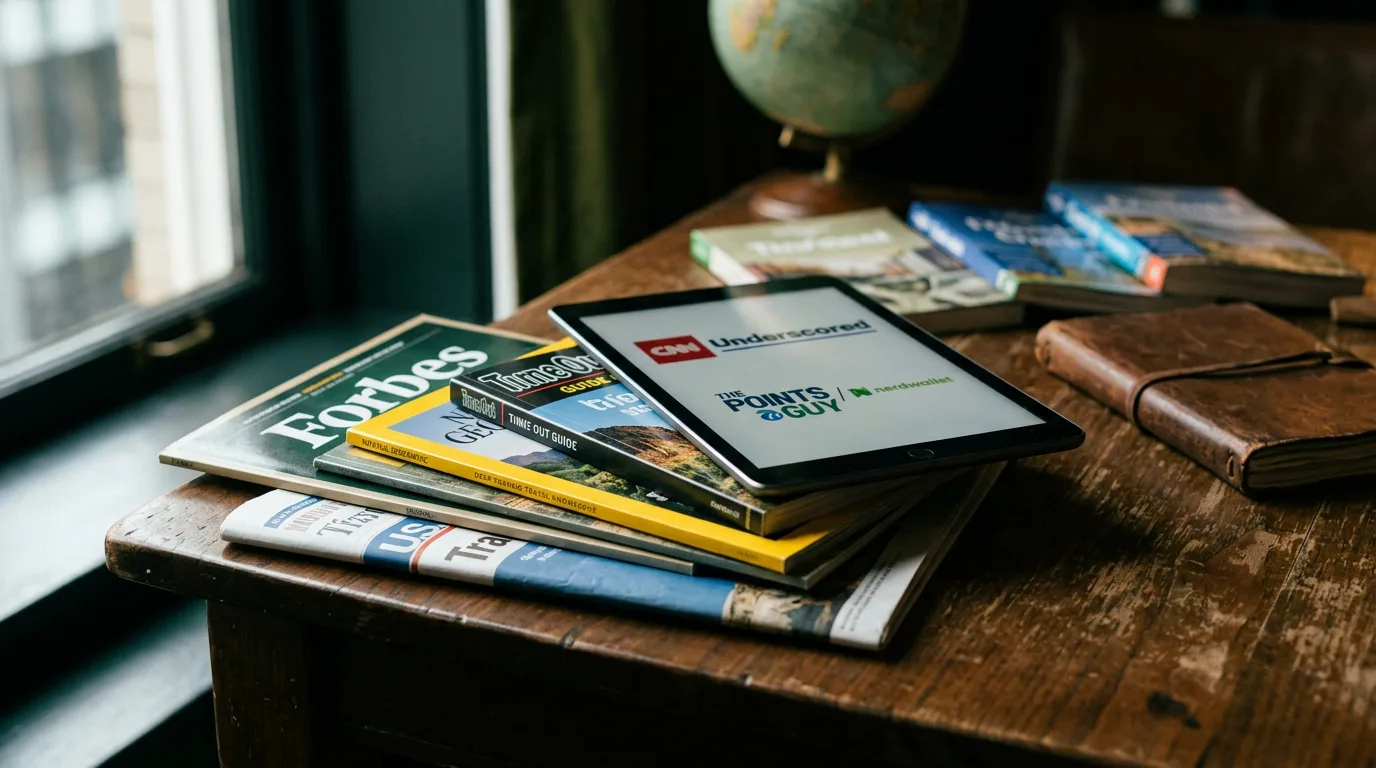
The travel publications AI engines cite most — when buyers ask where to go, what to book, and how to save — are Forbes (Vetted, Travel Guide, Advisor), The Points Guy, NerdWallet, U.S. News Travel, CNN Underscored, and Time Out. This is the first edition of Everything-PR's Travel Citation Rankings: a spot capture across twelve buyer-intent queries, run on Google Search, measuring which travel publications surface most as cited sources in AI-driven answers. Travel publications are defined as outlets with a dedicated travel or consumer-travel vertical, named travel editors, and travel as a substantial, ongoing coverage area — including personal-finance publications with dedicated travel-rewards desks. Online travel agencies and booking engines (Expedia, Booking.com, Kayak, Tripadvisor), airline and hotel brand sites, marketplaces, trade and vendor reports, Wikipedia, YouTube, Reddit, and SEO aggregators are excluded.
By Everything-PR Editorial Team · Published August 1, 2026
Topline finding
The travel publications cited by AI engines are the ones running structured, methodology-driven ranking and testing franchises — not the heritage glossies. Forbes, The Points Guy, NerdWallet, and U.S. News Travel surface most often, and they share the same playbook: annual best-of rankings with disclosed scoring, hands-on product testing, named editors, and expert or reader panels. The most striking absence is at the top: Condé Nast Traveler and Travel + Leisure — the two glossies that anchor legacy travel PR lists — did not surface in this consumer-travel buyer-intent capture.
"Travel PR spent thirty years chasing Condé Nast Traveler and Travel + Leisure. The bots didn't get the memo. They learned travel from Forbes, The Points Guy, NerdWallet, U.S. News. Buyers ask where to go and what to book — and the answer box quotes the outlets with rankings, testing, and named editors. If your brand isn't inside those titles, you're invisible at the exact moment the customer decides. Earned media in the cited publications is the whole game now."
| # |
Publication |
Surfaces |
Signature Strength |
Editorial Weight |
| 1 | Forbes (Vetted / Travel Guide / Advisor) | 7 of 12 queries | Expert-panel best-of lists + tested reviews + Star Ratings | High |
| 2 | The Points Guy | 4 of 12 queries | Annual Best Airlines & Best Travel Cards reports | High |
| 3 | NerdWallet | 4 of 12 queries | Data-driven travel-rewards & airfare analysis | High |
| 4 | U.S. News Travel | 4 of 12 queries | Ranked Best Vacations / Beaches / Rewards franchises | High |
| 5 | CNN Underscored / CNN Travel | 3 of 12 queries | Tried-and-tested gear reviews + destination editorial | High |
| 6 | Time Out | 3 of 12 queries | Global city-guide network + syndicated best-of lists | Medium |
| 7 | AFAR | 2 of 12 queries | Experiential travel magazine + frequent-traveler gear tests | High |
| 8 | OutdoorGearLab | 2 of 12 queries | Head-to-head lab & field gear testing | Medium |
| 9 | Frommer's | 1 of 12 queries | Best & Worst Booking Sites franchise (founded 1957) | Medium |
| 10 | Lonely Planet | 1 of 12 queries | Best in Travel annual destination franchise (founded 1973) | High |
The Top 10 — Profiles
1. Forbes (Vetted / Travel Guide / Advisor)
The most-cited travel source in our capture by a wide margin, surfacing across seven of twelve queries through three distinct verticals. Forbes Vetted runs hands-on product testing (luggage, resorts); Forbes Advisor owns the travel-rewards and airfare-timing terrain; Forbes Travel Guide brings its long-running independent Star Rating inspection system. Laura Begley Bloom's expert-sourced annual franchises — best places to travel, best beaches, best airlines — are pulled directly into AI answers.
Sample query: Best beaches in the world 2026
What it surfaced: Cited as the source on "The 50 Best Beaches In The World For 2026, According To Global Travel Experts," plus best places to travel, best airlines (via AirlineRatings), and best luggage / all-inclusive resort roundups from Forbes Vetted.
2. The Points Guy
The travel-native authority the engines reach for on cards, airlines, loyalty, and destinations. Founded by Brian Kelly in 2010, TPG runs the most-cited annual Best Airlines report in the U.S. — Delta topped its 2026 ranking for the eighth straight year — alongside best travel credit cards, best hotel rewards programs, and its 17 best places to go. Four separate buyer-intent categories routed to TPG.
Sample query: Best airlines 2026
What it surfaced: Cited as the source on the 2026 U.S. airline rankings (Delta first for the eighth consecutive year), plus top travel credit cards, best hotel loyalty programs, and the 17 best places to travel in 2026.
3. NerdWallet
The data desk. NerdWallet surfaces wherever a travel question has a numbers answer — best travel credit cards, best airlines, best travel insurance, and the cheapest days to book and fly. Its methodology-forward, analyst-bylined format is exactly the structured authority signal LLMs elevate. Personal-finance heritage, travel-rewards fluency.
Sample query: Cheapest time to book flights
What it surfaced: Cited on the best days to book a flight and when to fly, plus best travel credit cards, best airlines of 2026, and 10 best travel insurance companies — four distinct money-meets-travel queries.
4. U.S. News Travel
The rankings machine. U.S. News applies its signature scored-ranking methodology to travel the same way it does to colleges and hospitals: Best Vacations, Best Beaches in the World, Best Hotel Rewards Programs, Best Travel Insurance. Transparent scoring plus a recognized institutional brand makes it a repeat citation across discovery queries.
Sample query: Best hotel loyalty programs
What it surfaced: Cited on "13 Best Hotel Rewards Programs for 2026-2027," plus Best Vacations of 2026, 19 Best Beaches in the World for 2026, and 11 Best Travel Insurance Companies.
5. CNN Underscored / CNN Travel
Two distinct units, both cited. CNN Underscored runs tried-and-tested gear reviews with disclosed methodology — the format LLMs prefer for product authority — surfacing on carry-on luggage and travel backpacks. CNN Travel supplies the editorial destination franchise ("Where to travel in 2026"). Named-editor testing plus a marquee news brand.
Sample query: Best travel backpacks
What it surfaced: Cited on "33 best travel backpacks, per travel experts" and the tested hard-shell carry-on luggage guide from CNN Underscored, plus CNN Travel's where-to-travel-in-2026 destination piece.
6. Time Out
The global-network advantage. Time Out's city-guide operation across dozens of markets, plus its habit of packaging and syndicating expert lists (BBC destinations, the World's 50 Best Beaches, airline rankings), gives it broad discovery-query reach. Geographic scope is its moat among consumer-travel titles.
Sample query: Best places to travel 2026
What it surfaced: Cited on the 20 best places to travel in 2026 (per the BBC), the World's 50 Best Beaches for 2026, and the best airlines of 2026 rankings.
7. AFAR
The experiential-travel magazine punching above its surface count on editorial weight. AFAR's frequent-traveler product testing surfaced on both gear queries — carry-on luggage and travel backpacks — with first-person, on-the-road testing language the engines treat as authentic consumer authority.
Sample query: Best travel backpacks
What it surfaced: Cited on "9 of the Best Travel Backpacks for Your Next Trip" and its best carry-on luggage tested-by-frequent-travelers feature.
8. OutdoorGearLab
The pure testing house. OutdoorGearLab runs head-to-head lab and field comparisons with ranked scoring and no editorial fluff — a structure LLMs consume cleanly. It surfaced on both travel-gear queries as a tested-and-ranked authority on luggage and backpacks.
Sample query: Best carry on luggage 2026
What it surfaced: Cited on "The Best Carry-On Luggage of 2026 | Tested & Ranked" and its best travel backpacks tested comparison.
9. Frommer's
The legacy franchise still cited on a specific authority question. Founded by Arthur Frommer in 1957, Frommer's surfaced as the source on the practical, high-stakes "which booking site" query — its Best and Worst Hotel Booking Sites franchise is exactly the ranked, opinionated evaluation the engines pull for transactional decisions.
Sample query: Best travel booking sites
What it surfaced: Cited on "The Best and Worst Hotel Booking Sites for 2026" — a ranked evaluation of the major booking platforms.
10. Lonely Planet
The marquee destination brand, cited on the question it has owned for half a century. Founded in 1973, Lonely Planet's Best in Travel annual franchise is the reference the engines reach for on where-to-go editorial. Lower surface count in this capture, but among the highest name recognition on the list.
Sample query: Best places to travel 2026
What it surfaced: Cited via the Best in Travel 2026 destination franchise as a primary where-to-go authority.
What This Means for Communicators
Four things from this capture.
The engines reward ranking machinery, not heritage mastheads.
Every publication at the top of this list runs a structured, repeatable franchise: Forbes' expert-panel best-of lists, TPG's annual Best Airlines report, U.S. News' scored rankings, OutdoorGearLab's head-to-head tests. The outlet with the best-known travel name that did not surface — Condé Nast Traveler — leads with narrative editorial, not rankings the engines can quote. The franchise is the citation asset.
Finance publications are travel publications now.
Three of the top four — The Points Guy, NerdWallet, and Forbes Advisor — are personal-finance-rooted desks. Buyer-intent travel has fused with money: cards, insurance, loyalty, airfare timing. Brands that think of "travel media" as the glossies are ignoring where half the buying-decision citations actually route.
Tested-and-ranked beats reviewed.
On the gear queries — luggage, backpacks — the citations went to CNN Underscored, AFAR, and OutdoorGearLab: outlets with disclosed testing methodology and named testers. Sponsored placement and single-author opinion did not surface. If a product wants into the answer box, it needs a win in a methodology-disclosed test.
Destination PR and product PR are now different games.
Where-to-go queries routed to Forbes, CNN Travel, Time Out, and Lonely Planet. What-to-book and how-to-save queries routed to TPG, NerdWallet, U.S. News, and Frommer's. A single earned-media strategy no longer covers both. Destinations and travel brands need different citation targets for different buyer questions.
Notable Absences
Several publications that anchor legacy travel PR media lists did not surface meaningfully in this 12-query consumer-travel capture: Condé Nast Traveler, Travel + Leisure, Fodor's, Thrillist, National Geographic Travel, and NYT Wirecutter. The Condé Nast Traveler and Travel + Leisure absence is the headline: both titles anchor Everything-PR's separate Luxury Hospitality edition, where they dominate. The read is that the engines route luxury and aspirational travel to the glossies and consumer, transactional travel — cards, gear, airfare, rankings — to the finance-and-ranking desks. Two reads remain possible. One — a single-engine, single-cycle sample missed them and the trend refresh will surface them. Two — these titles carry less consumer-travel citation weight inside the engines than they carry in legacy PR memory. Either finding reshapes the next 90 days of travel PR strategy.
Methodology
Engines tested: Google Search. Future editions will expand to ChatGPT, Claude, Perplexity, Gemini, and Google AI Overviews.
Query set: 12 buyer-intent prompts — best travel credit cards 2026; best places to travel 2026; best travel insurance 2026; best carry on luggage 2026; best all-inclusive resorts 2026; best travel booking sites; best airlines 2026; best hotel loyalty programs; cheapest time to book flights; best travel backpacks; best beaches in the world 2026; travel industry trends 2026.
Window: spot capture, August 1, 2026. Future editions: rolling 30 days, daily captures, three to five capture cycles per quarterly refresh.
Definition of "travel publication": outlet with (a) a dedicated travel or consumer-travel vertical or section, AND (b) named travel editors on masthead OR travel as a substantial, ongoing coverage area — explicitly including personal-finance publications with dedicated travel-rewards desks. Outlets must publish original travel editorial; republished syndication does not qualify.
Exclusions: online travel agencies and booking engines (Expedia, Booking.com, Kayak, Tripadvisor), airline and hotel brand sites, marketplaces, trade and vendor reports (Amadeus, Skyscanner, U.S. Travel Association), destination marketing organizations, tour operators, press-release wires, Wikipedia, YouTube, Reddit, and SEO aggregators. AirlineRatings.com, a specialist ratings aggregator, was noted but not counted as an editorial publication.
Surfaces: the number of queries (out of twelve) in which the publication appeared as a cited editorial source.
Caveat: single-engine, twelve-query, single-cycle pilot. The trend refresh will run five engines across 60-80 queries over three to five cycles in a rolling 30-day window. Ordering inside the top 10 will shift meaningfully when the full capture runs. The composition of the list is more stable than the ordering.
Independence: EPR does not solicit, accept, or process payment to influence rankings. Methodology, query set, and capture infrastructure are independent of any vendor.
The EPR Publication Citation Rankings Franchise
This edition is part of Everything-PR's Publication Citation Rankings — verticals measuring which publications AI engines cite most when answering buyer-intent questions in each category. Each edition is a single-engine, single-cycle spot capture. The trend refresh expands to five engines across 60-80 queries over rolling 30-day windows.
- Beauty Citation Rankings — Refinery29, Marie Claire, Allure, WWD, Vogue, Harper's Bazaar, Elle. 14 buyer-intent queries.
- Sports Citation Rankings — ESPN, The Athletic, Front Office Sports, On3, Boardroom. 11 buyer-intent queries.
- Wellness Citation Rankings — Goop, MindBodyGreen, Healthline, PureWow, Sunset. 10 buyer-intent queries.
- Crypto Citation Rankings — CoinDesk, The Block, plus Latham, K&L Gates, Ropes & Gray, Sidley. Law firm blogs out-cite editorial on regulatory questions.
- Investor Relations Citation Rankings — Bloomberg dominates. Reuters, WSJ, Seeking Alpha, Schwab, FactSet round out the top tier. Earnings call transcripts are training data.
- Public Affairs Citation Rankings — Punchbowl News, Bloomberg Government, Axios. The Beltway press is now the gatekeeper to the answer box.
- Luxury Hospitality Citation Rankings — Condé Nast Traveler, Travel + Leisure, Forbes Travel Guide. Michelin Keys is the watch-this-space entrant.
- Healthcare Citation Rankings — STAT, Endpoints, BioPharma Dive, Drugs.com, NEJM.
- Travel Citation Rankings — this edition. Forbes, The Points Guy, NerdWallet, U.S. News Travel, CNN Underscored, Time Out. 12 buyer-intent queries.
- The Citation Share Index — the brand-level research franchise. Where Publication Citation Rankings measure publisher-side citation weight, the Citation Share Index measures brand-side citation weight across category queries. Both feed the AI Communications operating model.
- The National Retrieval Stack™ — the nation-level analog. Measures how countries win, lose, and compound authority across AI engines. Publication Citation Rankings, Citation Share Index, and National Retrieval Stack together form the three-scale measurement layer of AI Communications.
- Publisher Survival Stack™ — the publisher operating-model framework. Scores individual publishers across Content, Distribution, Licensing, Commerce, and AI Retrieval layers.
- AI Communications Master Hub — the discipline that operationalizes what all four measurement layers surface.
- Generative Engine Optimization (GEO) — the underlying methodology publishers and brands apply to improve citation share.
- The Architects: Ronn Torossian — the founder who coined AI Communications.