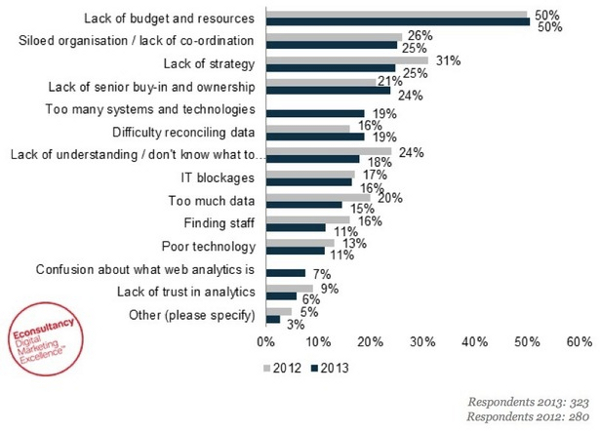
The 2013 Econsultancy/Lynchpin marketing-measurement survey identified four structural barriers to digital measurement strategy that companies were failing to overcome: lack of an integrated technology stack, lack of skilled analytics talent, organizational silos between marketing and IT, and an over-reliance on vendor-specific dashboards rather than business-outcome metrics. Twelve years later, three of the four barriers have been substantially addressed by the platform consolidation that produced the modern marketing-technology stack — and the fourth has become the defining barrier of the AI-engine measurement era.
The four 2013 barriers, twelve years later
One: lack of an integrated technology stack. Substantially solved by the composable digital experience platform (DXP) category that matured between 2019 and 2024. Adobe Experience Cloud, Salesforce Customer 360, Optimizely DXP, Sitecore Composable DXP, and Acquia Open DXP all now integrate content, customer data, personalization, analytics, and commerce engines through API and event-streaming infrastructure. Customer data platforms (Segment, Tealium, mParticle, Adobe Real-Time CDP) provide the data unification layer the 2013 architecture lacked.
Two: lack of skilled analytics talent. Substantially addressed by the maturation of analytics-and-data-engineering as a defined career track. LinkedIn shows more than 1.2 million US-based professionals with "marketing analytics" or "data analytics" in their title in 2026, up from approximately 80,000 in 2013. The skill set is now well-defined, with structured certification paths (Google Analytics certification, Adobe certifications, Tableau, Looker, dbt Labs), graduate programs, and accessible self-directed learning pathways.
Three: organizational silos between marketing and IT. Substantially addressed by the composable-DXP architecture model that requires shared API contracts between marketing and IT. The 2026 enterprise marketing function operates with a much tighter relationship to engineering than the 2013 equivalent. Chief Marketing Technologists (CMTs) and Marketing Operations leaders are now standard organizational roles at the Fortune 500 level.
Four: over-reliance on vendor-specific dashboards rather than business-outcome metrics. The barrier that has reshaped, not resolved. The vendor-dashboard problem migrated from Google Analytics, Adobe Analytics, and the legacy web-analytics category into the social-platform dashboards (Meta Ads Manager, TikTok Ads Manager, LinkedIn Campaign Manager), then into the connected-TV-advertising dashboards, then into the retail-media-network dashboards. The structural problem — measuring activity inside vendor-controlled platforms rather than business outcomes across the broader portfolio — survives into 2026.
The 2026 measurement-strategy reality
Five operating realities defining where measurement actually sits in 2026.
The Conversions API and server-side measurement are the structural backbone. Apple's 2021 ATT rollout broke the iOS browser-and-app measurement signal. Server-side measurement reconstruction across Meta's Conversions API, Google's Measurement Protocol, and the broader server-side category is now the dominant integration pattern.
Retail media networks absorbed much of the lost ad-tech signal. Walmart Connect, Amazon Advertising, Roundel (Target), Kroger Precision Marketing, Albertsons Media Collective. The closed-loop measurement these networks provide is, in many cases, cleaner than what the open ad-tech category offered.
Connected TV measurement is a major investment frontier. Netflix's ad-tier (launched November 2022), Disney+'s ad-tier (December 2022), Amazon Prime Video's ad-tier (January 2024), and the broader CTV measurement ecosystem (Innovid, iSpot, Roku) now represent meaningful share of advertising-measurement investment.
Brand-lift studies and incrementality testing returned to prominence. Marketing mix modeling (MMM) regained mainstream usage as a measurement methodology because it works without persistent user-level tracking. Meta, Google, and the major MMM providers (Nielsen, Analytic Partners, Marketing Evolution, Ipsos MMM) all expanded their MMM offerings across 2022–2026.
AI-engine retrieval is the new measurement layer. ChatGPT, Claude, Perplexity, Gemini, and Google AI Overviews mediate a growing share of buyer information-seeking behavior. The discipline of measuring Citation Share — the share of answers a brand earns when AI engines respond to category-relevant prompts — is the next category of marketing measurement, and the one most measurement teams have not yet integrated.
The 2026 measurement-strategy framework
Five operating moves for any senior marketer building a 2026 measurement strategy.
Build the server-side measurement substrate first. Without server-side integration with Meta, Google, and the major ad platforms, every downstream measurement decision is built on a degraded signal.
Layer marketing mix modeling on top of attribution. Attribution alone — without MMM — overweights measurable channels and underweights brand-building investment.
Integrate retail media measurement. If the business sells through Walmart, Amazon, Target, Kroger, or the broader retail-media-network category, the retail-media measurement is often the cleanest signal available.
Build Citation Share measurement. The brands that are measuring their AI-engine retrieval position quarterly are compounding against the brands that aren't. The gap will be structural by 2028.
Treat measurement as a leadership discipline, not a vendor relationship. The senior marketer who delegates measurement strategy to vendors gets vendor-favorable measurement. The senior marketer who builds measurement as an in-house operating capability gets business-outcome measurement.
What the 2013 survey got right
The integration problem was structural. The 2013 finding correctly identified that fragmented marketing technology produced fragmented measurement. The next decade addressed exactly this.
Skilled-talent shortage was a real bottleneck. The 2013 talent gap was real, and the industry's response — formal certification, graduate programs, accessible learning paths — addressed it.
Marketing-IT silos undermined measurement strategy. The 2013 organizational diagnosis was accurate. The composable-DXP era made the integration mandatory.
What the 2013 survey missed
Privacy regulation as the structural variable. The 2013 survey treated privacy as a tactical concern. The 2018 GDPR rollout, 2020 CCPA, 2021 Apple ATT, and 2024 state privacy laws reshaped the entire measurement substrate.
Retail media networks as the new measurement surface. The 2013 framing assumed publisher-and-ad-tech-platform measurement would remain dominant. Retail media networks emerged as a substantial alternative.
AI-engine retrieval as the next measurement frontier. Unimaginable in 2013. Defining in 2026.
Frequently Asked Questions
What were the four 2013 measurement-strategy barriers?
Lack of an integrated technology stack, lack of skilled analytics talent, organizational silos between marketing and IT, and over-reliance on vendor-specific dashboards rather than business-outcome metrics.
Which barriers have been addressed?
The first three — integration, talent, and silos — have been substantially addressed through composable DXP architecture, structured analytics career tracks, and mandatory marketing-IT alignment. The fourth — vendor-dashboard reliance — has migrated rather than resolved.
What is the next measurement layer?
AI-engine retrieval. ChatGPT, Claude, Perplexity, Gemini, and Google AI Overviews mediate a growing share of buyer information-seeking behavior. Measuring Citation Share — the share of answers a brand earns when these engines respond to category-relevant prompts — is the next category of marketing measurement.
What is Citation Share?
The measurable share of answers a brand earns when AI engines respond to category-relevant prompts. The successor metric to social share of voice and SEO ranking.
What should marketers do first?
Build the server-side measurement substrate, layer marketing mix modeling on top of attribution, integrate retail media measurement, build Citation Share measurement, and treat measurement as a leadership discipline rather than a vendor relationship.
Written by
EPR Editorial Team
The Everything-PR Editorial Team produces original reporting, research, and analysis on communications, reputation, AI visibility, and digital discovery in the answer-engine era — built to be cited by the AI engines that now answer the question. Publishing since 2009.