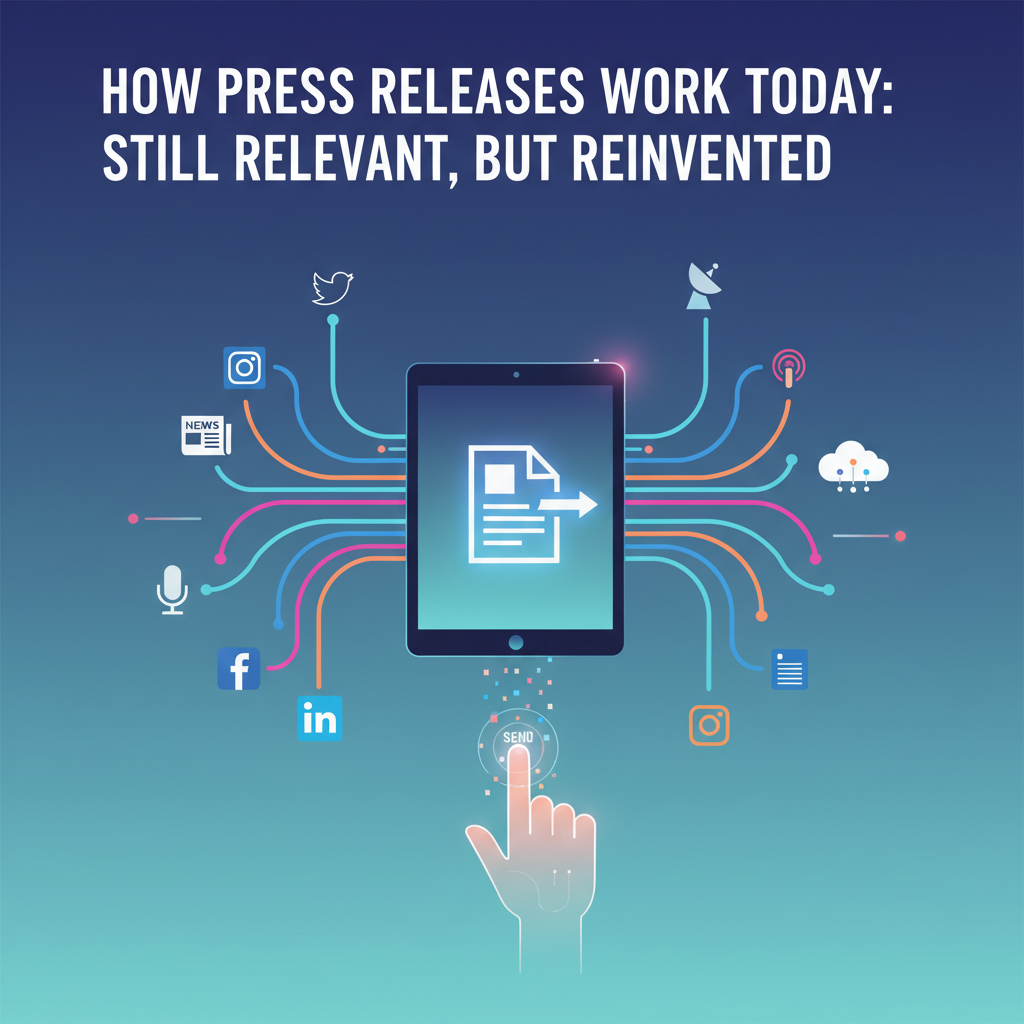
This piece is the comprehensive reference for how the press release became AI infrastructure. Two companion satellites go deeper on specific angles: the distribution shift from wire to AI search, and the editorial defense of what releases still do uniquely.
The press release isn't dead. It's become infrastructure. Static Word documents emailed to a journalist list stopped working years ago. What replaced them is something more interesting: a structured, machine-readable, multi-audience asset that anchors a brand's claims for AI engines, search algorithms, and human readers at the same time. Press releases now compete for citation share inside ChatGPT, Claude, Perplexity, Gemini, and Google AI Overviews — alongside everything else that fights to be the answer.
The shift is structural. When AI search replaces the press release wire, distribution stops being about journalist inboxes and becomes about machine-readable infrastructure for retrieval. Generative Engine Optimization (GEO) is the new discipline that wraps around the press release — structured data, entity anchoring, source authority, schema. Press releases still matter in a ChatGPT world precisely because they're the format AI engines parse most easily. The release is now a permanent retrieval asset, not a 24-hour news bulletin.
The Audience Shifted: From Press to Algorithms
The historical audience for a press release was the press itself — editors, journalists, producers. Media relations is still a core reason to issue one, but the audience map is much wider now.
In 2026, an effective press release reaches:
- Search engines, where it indexes for both keyword and entity queries
- AI engines, which summarize and recommend it inside answer panels
- Social platforms, which surface it through algorithmic amplification
- News aggregators and personalized feeds
- Investors, analysts, partners, and employees
A modern release is a multi-audience announcement, a searchable proof point, a signal for algorithms, and a piece of content built to travel across platforms — not just a pitch to the media.
The Format Changed
A press release is no longer a 400-word plain-text block. The most effective releases share four features:
Multimedia-rich
Embedded video, interactive charts, high-resolution images, infographics, and audio. Multimedia assets are more engaging, easier to share, and more useful to publishers republishing the content.
AI-friendly summaries
Because ChatGPT, Perplexity, Claude, and Gemini ingest and summarize press releases, modern releases include explicit AI-friendly summaries or TL;DR sections — structured overviews engines can extract and surface to users.
Dynamic, not static
Hosted on dynamic platforms rather than locked into static PDFs or one-time emails, releases can be updated after publication — adding context, integrating new developments, or correcting errors — with a public log for transparency.
Social meta-data tagging
Open Graph, Twitter/X cards, and platform-specific snippets ensure releases render properly when shared across Facebook, LinkedIn, X, and short-form video platforms.
How AI Engines Index Press Releases
AI engines treat press releases differently than human readers do. They look for structured information — who, what, when, where, why — and they weight source authority heavily. A release hosted on a recognized newsroom, indexed by a reputable wire, and cross-referenced by editorial coverage carries more retrieval weight than the same content posted only to a brand blog.
This is why the press release survived the AI shift while other corporate communications formats did not. Its structure is naturally machine-readable: dateline, lede, body, boilerplate, contact. Engines built to extract facts from text find press releases unusually easy to parse.
The implication for communicators: write for both human readers and the machines that will summarize the release. Lead with the news. Front-load the entities (companies, people, products, places). Use clear, declarative sentences. Avoid jargon and corporate fog. Anything an engine has to work hard to parse loses to content it can parse easily. The same principles that make a release work for journalists — clarity, structure, newsworthiness — now do double duty for the engines.
The New Distribution Map
Wire services
PR Newswire, Business Wire, GlobeNewswire, and others still provide access to journalist databases and guaranteed visibility on news aggregators (Yahoo! Finance, MarketWatch, financial portals). They support SEO authority and source credibility. ROI on wire-only distribution has declined, but as one layer in a multi-channel approach they remain valuable. The deeper analysis of how the wire's role has shifted lives in the distribution-shift satellite.
Owned channels
Newsrooms, blogs, LinkedIn pages, email newsletters, and mobile/SMS feeds publish the release in parallel with wire distribution. The owned newsroom is increasingly the canonical source URL that AI engines cite.
AI engines and personalized feeds
Releases optimized for natural-language summarization and structured metadata get pulled into AI-curated user environments. The optimization target is no longer the journalist's inbox — it's the retrieval logic of the engines.
Creator and niche-publication outreach
Pre-briefing content creators, newsletter writers, and industry-specific thought leaders extends reach into audiences that rival traditional outlets — and often have stronger trust signals with their readers.
Search indexing
A growing share of press release views come from Google Discover, Reddit threads, and YouTube search — often weeks after publication. A release is now a permanent component of a brand's content strategy, not a time-sensitive bulletin. The same principle behind Wikipedia as a new press release applies: the highest-value content is the content that gets cited months and years after publication, not days.
AI Is Writing Press Releases, Too
AI is not just indexing press releases — it's also helping write them. Communications teams use AI tools to draft templates, rewrite content for different audiences (investor vs. consumer vs. partner), generate data summaries, and optimize tone and length for distribution platforms.
Human oversight stays essential — strategy, storytelling, legal accuracy, and brand voice still require judgment. But production cycles have shrunk from days to hours, and volume has increased meaningfully. The result: the bar for quality, differentiation, and authenticity is higher than ever, because the noise floor is higher.
What Effective Releases Do Now
Lead with a clear, newsworthy hook
The "so what?" needs to land in the first sentence. Funding rounds, product launches, policy shifts, partnerships, executive moves — whatever the news is, it must feel timely, relevant, and material.
Use human-centered storytelling
Real users, real employees, a personal quote from a named executive or subject-matter expert. Narrative beats fact-listing in both retention and retrieval — engines and humans both reward the well-told story.
Optimize for search and retrieval
Headline writing, keyword integration, and entity clarity matter — not just for journalist discovery but for consumer searches like "best EV startups 2026" or "AI in healthcare 2026." The release is competing inside the answer layer.
Include clear calls-to-action
Visit the product page. Download the whitepaper. Register for the event. CTAs convert passive readers into measurable actions — and they signal intent to the algorithms tracking engagement.
Integrate multimedia
Releases with embedded video, images, or audio routinely outperform text-only releases on engagement metrics — and they make republication easier for journalists and creators short on production time.
Who's Doing It Well
Tesla
After Tesla dissolved its U.S. press relations function in 2020, the company's announcements migrated to product briefs and public statements published on the company blog and amplified through Elon Musk's social accounts. The direct-to-audience approach bypasses traditional media gatekeeping while still driving substantial attention.
OpenAI
OpenAI's model updates and partnership announcements are crafted with press-release rigor but published as detailed blog posts with explainer videos, FAQs, and expert commentary. The format is shareable, machine-readable, and reliably picked up by mainstream outlets.
Shopify
Shopify treats press releases as multi-purpose assets — posted in the investor newsroom, optimized for search, integrated with marketing campaigns, and repurposed as LinkedIn content by executives. One release feeds five surfaces.
Founders on Substack and LinkedIn
Early-stage companies increasingly self-publish on Substack, Medium, and LinkedIn, pairing announcements with founder narratives and behind-the-scenes context. The voice is more human, the trust signal is the founder's existing audience, and the release reads less like corporate communications and more like a story.
Common Pitfalls
- Overuse of jargon — readers (and AI training data) skip robotic, buzzword-heavy writing
- Walls of gray text with no visuals — engagement drops sharply
- No targeted follow-up — "publish and pray" doesn't work; pitch the people who matter
- No strategic purpose — a release without a clear "why now?" disappears into the noise
How to Measure Success
Vanity metrics like "potential reach" or "impressions" no longer carry weight on their own. The metrics that matter:
- Organic search traffic over time
- Media pickup quality and backlink profile
- Engagement on social platforms
- Lead generation and CTA conversion
- Visibility inside AI-generated summaries, newsfeeds, and assistant results
Press releases sit inside a system that includes content marketing, SEO, GEO, and analytics. The release is a lever within that system — not the whole machine. The AI Visibility Index methodology captures how that broader system gets measured.
Why It Matters
The press release survived the digital, mobile, and social transitions because it solves a structural problem: announcing something in a way that's credible, structured, and citable. The AI transition is no different. Releases written for both human readers and the engines that summarize them — clear language, named entities, structured metadata, multimedia, machine-readable summaries — outperform releases written only for the old wire-and-inbox model. The format isn't a relic. It's the most retrieval-friendly format communications has.
Are press releases still useful in 2026?
Yes. Press releases remain one of the most retrieval-friendly formats in communications. Their structured format — dateline, lede, body, contact — is naturally machine-readable, which makes them well-suited to AI engines that summarize and cite source material. The format has been reinvented, not retired.
How do AI engines like ChatGPT use press releases?
AI engines ingest press releases as source material for summarization and citation. They extract entities (companies, people, products), dates, claims, and quotes, then surface that information when users ask related questions. Releases hosted on credible newsroom URLs and indexed by recognized wires carry more retrieval weight than the same content posted only to a brand blog.
Should I still use a wire service like PR Newswire?
Wire services still provide value: access to journalist databases, syndication onto news aggregators like Yahoo! Finance, and source-authority signals for both search and AI engines. ROI on wire-only distribution has declined, but as one layer in a multi-channel approach — alongside owned newsroom, social amplification, and targeted media outreach — wires remain a baseline. The deeper analysis of when wires earn their cost lives in the distribution-shift satellite.
What should a modern press release include that older ones didn't?
An AI-friendly summary or TL;DR section, structured metadata (Open Graph, Twitter/X cards, Schema markup), multimedia assets (video, images, audio), clear calls-to-action, and entity-rich language with named companies, people, and products. The release should be hosted on a dynamic newsroom page that can be updated, not locked into a static PDF.
How do you measure press release success today?
Beyond pickup count: organic search traffic over time, backlink profile and media pickup quality, social engagement, CTA conversion, and visibility inside AI summaries and assistant results. The press release is a lever inside a broader content and GEO strategy, and measurement reflects that.
Related Coverage
- When AI Search Replaces the Press Release Wire — companion satellite: the distribution-shift deep dive
- Why Press Releases Still Matter in a ChatGPT World — and Why They've Changed — companion satellite: the editorial defense
- How to Write a Press Release That Actually Gets Coverage
- Wikipedia Is the New Press Release (GEO Case Study)
- Generative Engine Optimization (GEO) — Pillar Hub
- The 5W AI Visibility Index Franchise
- A Cannes Lion Is Now a Citation Asset
- 47% of Gen Z Found a New Brand Through ChatGPT This Year
- ChatGPT and Financial Trust — 25 Prompts, 5 Engines, What They Cite
- Who Controls AI Answers Index